
Forecasting Algorithms Made Easy: How Planisware Turns Expert Judgment Into Portfolio Confidence
Forecasting is at the heart of portfolio decision-making. It shapes investment choices, staffing plans, delivery commitments, and executive confidence. Yet for many organizations, forecasting still feels harder than it should: models are either too simple to be trusted or too complex to be easily maintained.
Planisware’s Min-Max Parametric Estimation capability offers a practical middle path. It helps organizations – regardless of their industry and internal processes – capture the knowledge of subject matter experts, translate it into repeatable forecasting logic, and generate transparent resource forecasts that can scale across projects, programs, and portfolios.
Why Forecasting Often Breaks Down
Most organizations rely on a mix of historical data, spreadsheets, expert input, and project manager experience to forecast resource demand. These inputs are valuable, but they often become difficult to apply consistently when portfolios grow more complex.
- Forecasts vary significantly between teams and departments.
- Complex algorithms become difficult to maintain.
- Resource managers struggle to explain how estimates were derived.
- Forecasting models require specialized expertise to update.
- Planning assumptions become disconnected from operational reality.
The result is familiar: teams debate the forecast instead of using it to make better decisions. Resource managers struggle to explain how numbers were calculated, business leaders question whether assumptions are comparable, and PMOs spend too much time maintaining models instead of improving planning outcomes.
"With Planisware Min-Max Estimation, organizations can create more intuitive and adaptable forecasts, accelerate planning changes, minimize technical dependencies, and empower resource managers to focus on strategic decision-making rather than debugging formulas."
A Simple Idea: Forecast as a Range, Not a Guess
Planisware Min-Max Parametric Estimation starts with a simple principle: for a given activity, there is usually a minimum level of effort and a maximum level of effort. The real forecast should fall somewhere between the two, depending on the characteristics of the work.
Instead of asking teams to build complicated formulas from scratch, the methodology guides them through a structured process:
- Define minimum and maximum effort values.
- Identify key drivers or leading indicators.
- Rank possible indicator values.
- Weight the relative importance of indicators.
- Apply project-specific indicator values.
- Generate forecasts automatically.
Example: planning a dinner party. Imagine you need to forecast the effort required to prepare, cook, and clean up after a dinner party. Preparing ingredients may take only 30 minutes if everything is pre-prepped, but closer to an hour if the ingredients are whole and need more hands-on work. Cooking effort depends on the desired tenderness and the cooking method: a pressure cooker, braise, or sous-vide preparation will not require the same amount of time. Clean-up may be quick with disposables and a dishwasher, or much longer with hand-washed fine china.
Image
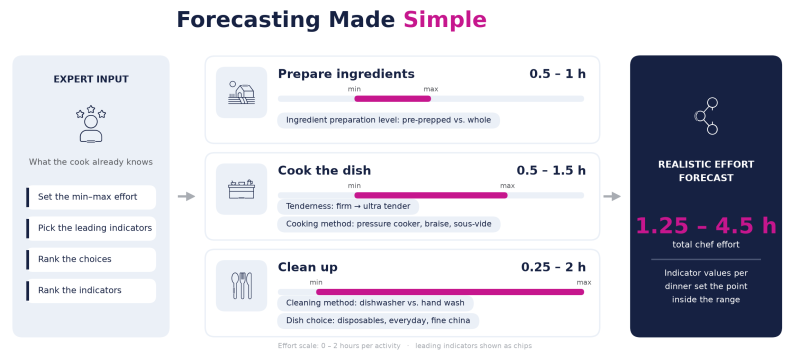
Expert judgement in, a realistic effort range out. The Min-Max method on an everyday example.
This everyday example makes the method easy to grasp. The planner defines minimum and maximum effort, identifies the leading indicators that influence the outcome, ranks the choices, and lets the algorithm calculate a realistic forecast. The same logic applies to project work: expert judgment becomes a repeatable, explainable model that works across industries and processes.
From Expert Intuition to Repeatable Forecasting Logic
The strength of the Min-Max approach is that it does not ignore expert intuition. It structures it.
In Planisware, organizations can define leading indicators that influence the forecast. These are the business factors that experts already use informally when they think about complexity, duration, workload, or resource demand.
For each activity, teams can define:
- What activities require the least effort?
- What activities require the greatest effort?
- Which complexity drivers matter most?
- How should different scenarios be ranked?
Image
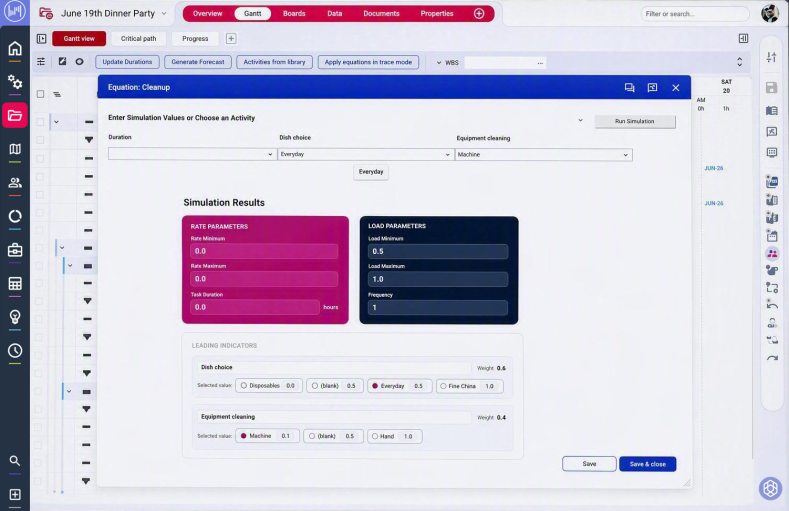
Planisware Min-Max forecasting captures expert assumptions, weighs what matters, and turns them into a realistic effort range.
The result is a forecast that remains grounded in real-world expertise while gaining the consistency of a parametric engine. Stakeholders can understand why an estimate falls closer to the minimum, the maximum, or somewhere in between.
Making Resource Forecasts More Complete
Reliable resource planning also requires a complete view of capacity. Project work is only part of the picture. People also spend time on operational activities, cross-project support, governance responsibilities, training, meetings, and time off.
Planisware helps organizations model project-specific demand alongside broader capacity assumptions, giving PMOs and resource managers a more accurate view of workforce availability and constraints.
This results in:
- Better visibility into capacity constraints.
- Earlier identification of resource bottlenecks.
- More realistic staffing assumptions.
- Improved workload balancing across functions.
- Greater transparency for portfolio decision-makers.
Designed to Evolve Without Becoming Overly Complex
Forecasting models should evolve as teams learn more, collect better data, and refine how work is delivered. But evolution should not mean rising complexity.
Planisware supports this through a modular, table-driven framework. Rate-based estimates, load-based estimates, quantity factors, fixed effort elements, attenuators, and modulators can be combined where needed, while keeping the model understandable and maintainable.
Organizations can also apply controlled adjustments when unique project circumstances arise, while keeping forecasts connected to the underlying estimation model rather than relying on disconnected manual overrides.
This balance matters because forecasting is not just a technical exercise. It must be trusted by project teams, resource managers, PMOs, and executives alike.
Faster Forecasting, Lower Maintenance Effort
Traditional parametric estimation can deliver powerful results, but it has often required specialized expertise, complex logic, and significant maintenance. That can slow down adoption and make updates dependent on a small group of technical specialists.
Planisware’s Min-Max methodology lowers that barrier. By using business-oriented inputs and configurable tables, organizations can adapt forecasting assumptions more quickly while maintaining governance and consistency across the portfolio.
This enables teams to make forecasting updates faster, reduce dependency on technical specialists, and create models that are easier for business stakeholders to understand and trust.
Better Forecasts, Better Portfolio Decisions
The purpose of forecasting is not to produce a more elegant number. It is to support better decisions.
When organizations understand likely effort ranges, resource constraints, schedule pressure, and capacity trade-offs, they can make stronger decisions about which projects to fund, when to start them, and how to staff them realistically.
- Identify potential overruns earlier.
- Evaluate alternative scenarios with greater confidence.
- Improve prioritization decisions.
- Optimize portfolio investments.
- Enhance executive visibility into delivery risks and opportunities.
This is where Planisware connects forecasting to strategic portfolio management. Forecasts become inputs to scenario planning, prioritization, resource allocation, and executive decision-making. Instead of reacting to capacity issues late in execution, leaders gain earlier visibility into risks, trade-offs, and opportunities.
Key Benefits of Planisware Min-Max Parametric Estimation
- Combine expert judgment with scalable forecasting algorithms.
- Create more transparent and consistent resource forecasts.
- Capture business complexity through configurable leading indicators.
- Reduce forecasting maintenance effort through table-driven configuration.
- Improve capacity planning and portfolio visibility.
- Support more informed portfolio investment and prioritization decisions.
Bottom line: Planisware Min-Max Parametric Estimation makes forecasting algorithms easier to build, easier to explain, and easier to maintain. By turning expert judgment into structured, scalable forecasting logic, Planisware helps organizations move from forecast uncertainty to portfolio confidence.
Ready to move from uncertain forecasts to more confident portfolio decisions? Discover how Planisware can help you structure your forecasting models and strengthen your resource planning. Contact us for a personalized demo.