How structured decision logging transforms project governance – eliminating lost context, strengthening risk management, and building audit-ready project portfolios.
The Cost of Forgotten Decisions
Every significant project generates dozens of pivotal decisions: a scope change approved at a steering committee, a technology rollback triggered by a stability risk, a resource reallocation driven by strategic reprioritization. Each decision shapes the project’s trajectory. Yet in most organizations, those decisions evaporate, living only in the memory of whoever was in the room, buried in email chains, or lost entirely when team members transition.
The consequence is real and measurable. When a new project manager inherits a troubled initiative, they often have no idea why previous choices were made. When an auditor asks for evidence of governance sign-off, there is none. When a risk that was deliberately accepted later materializes into a crisis, no one can locate the original rationale that justified that acceptance. Context - the institutional knowledge embedded in why decisions were made - is the most under protected asset in project portfolio management.
According to PMI’s 2023 Pulse of the Profession, 92% of high-maturity PMOs play an essential role in strategic planning and execution alignment. Yet governance quality depends entirely on the quality of the records underpinning it. A PMO cannot align strategy with execution if the decisions that link the two are invisible.
Planisware addresses this governance gap directly. The Decisions feature gives project managers and PMOs a structured, searchable, portfolio-wide decision log, turning one of project management’s most persistent blind spots into a strategic asset.
The PMI Framework: Decisions as a Pillar of Project Governance
The importance of decision logs is foundational to the global standards that govern professional project management. The PMI’s PMBOK® Guide identifies historical information as organizational process assets of high strategic value, providing insights into both the decisions taken and the results of those decisions in previous similar projects.
Moreover, key governance pillars – encompassing Accountability and Responsibilities, Risk and Issue Management, Stakeholder Communication, and Project Management Control Processes – cannot function effectively without a reliable record of what was decided, by whom, and why.
There is a strong connection between decisions and risks. To increase the likelihood of project success, organizations need to anticipate and manage risks proactively and improve decision-making. But Decisions made in response to identified risks are only governable when they are captured.
The PMI Framework Connection:
PMI standards consistently link governance quality to the completeness of decision records. From organizational process assets in PMBOK® Fifth Edition to the enterprise risk management lifecycle in the 2024 Risk Practice Guide, the message is consistent: undocumented decisions are ungoverned decisions.
PMI’s first-ever Project Management Offices: A Practice Guide (February 2025) extends this logic to the portfolio level. It positions PMOs as strategic assets, providing executives with “a strategic perspective on how PMOs can drive organizational success, helping them make informed decisions about PMO investments and strategic direction.” That strategic perspective requires visibility − and visibility requires decisional data that today often does not exist.
Most Common PPM Governance Decisions
Based on the PMI’s PMBOK® Guide, the 2024 Risk Practice Guide, and the 2025 PMO Practice Guide, here are the most common governance decisions in high-performing project portfolio management organizations, with their typical rationale and the value of capturing them.
| Decision Type | Typical Rationale | Benefits of Capturing Decisions |
| Portfolio Selection & Prioritization | Strategic alignment, budget availability, expected ROI, risk appetite. PMI defines portfolio management as centralized governance to achieve strategic objectives. | Prevents the same prioritization debate every cycle; provides a documented answer when teams challenge why their project was deferred or cancelled. |
| Project Authorization (Go/No-Go at Initiation) | Project aligns with strategy, has a sponsor, realistic business case, and available resources. | Establishes original intent and constraints; resolves future scope disputes ("that was never in scope") by reference to the authorization record. |
| Phase-Gate | Deliverables from prior phase meet quality criteria, resources are available, risks are acceptable, strategic fit confirmed. Phase end reviews are the formal proceed/hold/kill decision points. | Creates a governance timeline invaluable in audits; prevents disputes about what conditions were attached to a "proceed" decision. |
| Scope Change Approval | Change is necessary to meet a business or regulatory need; impact on schedule, cost and quality has been assessed and approved. Change Control requires formal review before any baseline modification. | Explains budget overruns and schedule slippage; protects the team with a dated record of what was approved and by whom. |
| Resource Reallocation | Strategic reprioritization, skills scarcity, or critical path risk on a higher-priority project. | Allows the PMO to model the true downstream cost of reallocation; decisions log surfaces recurring bottlenecks and systemic resource risks across the portfolio. |
| Risk Response | Based on probability × impact score, risk appetite, and cost of mitigation vs. cost of impact. Response decisions are the action-trigger of the full risk lifecycle. | Closes the accountability loop when risks materialize; demonstrates to auditors that risks were actively managed, not overlooked. |
| Budget Variance Approval / Reserve Release | Unforeseen complexity, approved scope change, realized risk, or market price fluctuation. Control costs define the conditions under which reserves may be accessed. | Provides the documented justification auditors require; demonstrates financial governance discipline and sponsor authorization chain. |
| Project Suspension / Hold | External dependency unresolved, funding not confirmed, key resource unavailable or strategic priority temporarily downgraded. | Preserves institutional knowledge for restart; explains the current project state to a new team without hours of reconstruction. |
| Project Cancellation | Business case no longer valid, strategic direction changed, costs exceed value threshold, or external factor makes the project moot. | Protects the PMO from accusations of arbitrary decisions; enables a proper project closure, lessons learned process and clean release of committed resources. |
| Escalation | Issue exceeds the project manager's authority; requires cross-project trade-off; carries reputational or regulatory risk. Escalation processes are essential for effective communications. | Closes the accountability loop between project and executive governance; prevents the "no one told me" problem when issues become crises. |
| Vendor / Procurement Selection | Best value, technical fit, risk profile, strategic relationship, or regulatory compliance. Procurement lifecycle and selection is the central governance decision. | Provides the documented evaluation rationale required for compliance audits and supplier challenge processes. |
| Compliance Waiver / Exception | Requirement cannot be met within current constraints (legislative, regulatory, etc.); risk of non-compliance has been assessed and accepted; compensating control is in place. | Transforms a potential compliance breach into a documented, defensible governance act − critical in regulated industries (pharma, financial services, aerospace, for example). |
Every decision category above shares a common characteristic: it involves named accountability, material consequences, and a high probability of being questioned later – by auditors, new team members, regulators, or project sponsors. Decision logs are visible, traceable, and organizationally retained. When projects fail, stakeholders often blame the PMO − specifically, poor governance. Capturing these decisions is precisely what separates a PMO that administers projects from one that governs them.
Introducing the Planisware Decisions Feature
The Decisions feature in Planisware is a purpose-built decision log that enables project managers to identify, record, and track every significant decision made throughout the project lifecycle. It brings structure to what has historically been an informal, ad hoc process.
Each decision entry captures the essential governance record: the owner responsible for the decision, the creation date, a structured description of the decision taken, the activity or project phase to which it relates, and a notepad field for full rationale, context, and supporting detail. The result is a governance-grade audit trail attached directly to the project.
Logged Decisions become a living record – updated at each steering committee, risk review, or phase gate – that travels with the project from initiation through closure.
Key Benefit: Knowledge Retention
Track decisions throughout the project lifecycle to ensure that projects proceed smoothly. When team members change, when phases shift, or when disputes arise, the decision log provides an authoritative, timestamped account of what was agreed and why − eliminating the “we never decided that” problem once and for all.
From Project to Portfolio: Decision Visibility at Every Level
Individual project decision logs are valuable. But Planisware goes further: project decisions are automatically consolidated at the Portfolio level. The portfolio view presents a unified tab – alongside Dashboards, Projects, and Risks – that aggregates decision records across every project in the portfolio into a single, searchable, sortable interface.
Image
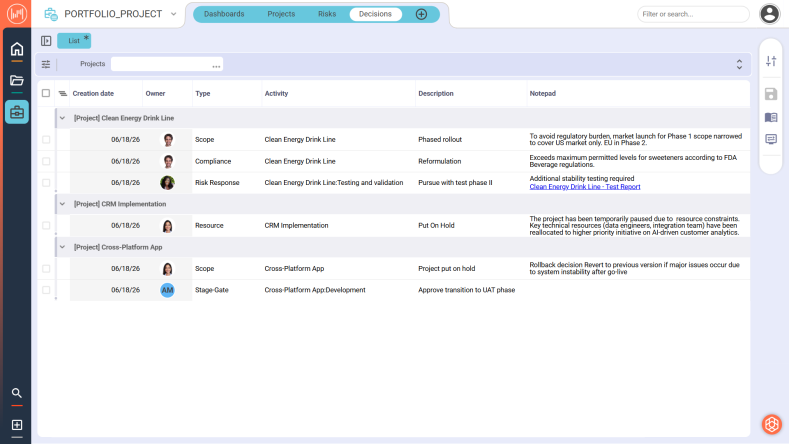
For PMO leaders, this consolidation is crucial. Rather than chasing decision records across individual project files, the PMO can see, at a glance, what key decisions have been made across the entire portfolio, who owns them, when they were made, and what activities they relate to. Portfolio-level decision visibility supports several critical PMO functions:
- Pattern recognition: Identify recurring decision types − scope holds, resource reallocations, technology rollbacks − that may signal systemic portfolio risks.
- Cross-project learning: Share decision rationale across project teams, turning individual project experience into organizational best practice.
- Executive briefing: Provide leadership with a clear, evidence-based account of how the portfolio is being governed, without requiring them to drill into individual project records.
- Governance assurance: Demonstrate to executive boards, auditors, and regulators that material decisions are being captured, tracked, and accountable to named owners.
“Formalize decision-making through Executive Steering Committees and Portfolio Managers to ensure every project aligns with strategy. Move beyond individual project logs and use a portfolio-level framework to identify and proactively mitigate systemic risks.”
Decisions & Risk Management: Quantify, Visualize, Govern
Risk management and decision management are inseparable. Every material risk response is a decision. Accepting a risk, escalating it, transferring it, or implementing a contingency plan − each of these actions generates a decision that must be owned, justified, and tracked. Without a decision log, risk responses become invisible, and the governance loop is broken.
Planisware provides a fully integrated risk management environment that spans the complete risk lifecycle − from identification and qualitative scoring to quantitative analysis, response planning, and monitoring. Risk scoring in Planisware uses the probability × impact matrix, enabling teams to categorize risks by severity and prioritize response actions accordingly.
Executives and portfolio managers gain immediate situational awareness through automated heat map visuals and risk dashboards. Rather than requesting a manual risk status report, leadership can open the portfolio risk view and immediately understand the distribution of high, medium, and low-severity risks across all active projects and see which risks have triggered decision entries.
Risk–Decision Loop: Closing the Gap
When a risk materializes or a response is approved, that moment of decision should be captured. For example, a rollback decision triggered by a system stability risk or a resource reallocation triggered by a capacity constraint is logged in Decisions with full rationale, linked to the relevant activity. The risk register and the decision log reinforce each other, creating a complete, traceable governance record from risk identification through response to outcome.
This integration directly addresses one of the most common PMO pain points: executives who need quick insight into risk exposure without wading through raw risk registers. The combination of risk heat maps, scored risk dashboards, and linked decision entries gives senior leaders the qualitative picture (which risks are most severe?), the quantitative picture (what is the probability-weighted impact?), and the governance picture (what decisions have been made in response?) – all in one place.
PMI’s 2024 Risk Practice Guide defines the risk management life cycle as an integrated process encompassing identification, analysis, response planning, implementation, and monitoring. Planisware maps to all five stages, with the Decisions feature providing the governance record that links analysis to response and ensures that every risk-driven decision is traceable back to its trigger.
Decisions & Compliance: Building Audit-Ready Projects
Compliance is increasingly non-negotiable. Whether an organization operates in a regulated industry such as pharmaceuticals, financial services or aerospace or is subject to internal governance frameworks and corporate audit requirements, PMOs are under pressure to demonstrate that projects are managed within defined compliance boundaries. The cost of failure is not merely reputational: it can be financial, legal, and operational.
The Planisware Decisions feature addresses compliance governance at two levels: proactive controls and retrospective audit trails. PMOs can configure compliance checkpoints as milestone decisions, ensuring that each checkpoint in a project’s lifecycle generates a mandatory decision entry. If a checkpoint is bypassed or its decision record is incomplete, the audit trail reveals the gap – before an auditor or regulator does.
When an internal or external auditor asks, “who approved this, when, and on what basis?”, the answer is in the Decisions log. Every entry is time-stamped, owner-attributed, and linked to a specific project activity. The portfolio-level consolidation means the PMO can produce a complete cross-project compliance record without assembling data from multiple disparate projects.
PMO Best Practices: Setting Up Decision Governance
The argument for structured decision logging is ultimately simple: you cannot govern what you cannot see, and you cannot learn from what you did not record. Projects fail not only because of bad decisions, but because of undocumented decisions − choices made without accountability, context lost, and rationale that disappears when people move on. Planisware’s Decisions feature directly addresses this governance blind spot.
But implementing decision governance effectively requires an approach aligned to the organization’s governance model. The following best practices will help PMOs maximize the value of Planisware’s Decisions capability.
| Best Practice | How to Apply in Planisware | Governance Benefit |
|---|---|---|
| Define decision categories | Use the Type field to tag decisions by type: Scope, Resource, Risk Response, Phase Gate, Compliance | Enables filtering, pattern analysis, and portfolio-level reporting by decision type. |
| Assign every decision an owner | Require the Owner field to be populated before a decision entry is saved | Establishes clear accountability; supports performance and audit reviews |
| Capture rationale, not just outcomes | Use the Notepad field to record the “why”: context, alternatives considered, and constraints | Preserves institutional knowledge; prevents costly re-decisions in later phases |
| Link decisions to risk entries | Reference the associated risk ID or risk description in the decision entry when logging a risk response | Creates a traceable risk-to-decision audit trail aligned with the PMI risk lifecycle |
| Set stage-gate decision checkpoints | Configure mandatory decision entries at each project phase gate as part of the project template | Ensures nothing advances without a formal, documented sign-off |
| Review at portfolio level weekly | Include the portfolio Decisions tab in the standard PMO governance review cadence | Surfaces cross-project governance issues early; supports executive briefings |
In Planisware, all decision types can be captured in the Decisions log, owned by a named individual, dated, tagged by type and by activity, and accessible at portfolio level. By providing a structured, activity-linked, portfolio-consolidated decision log embedded within the same platform used to manage risks, timelines, and resources, Planisware gives PMOs the complete governance picture they need.
Ready to see Planisware solutions in action? Contact us for a personalized demo.