Give PMOs the power to see every risk, govern with confidence, and make data-driven decisions that improve project success across the entire portfolio.
In project portfolio management, an old saying rings true: "Project risk will find you if you don't find it first." Effective risk management helps organizations anticipate threats, prepare responses, and protect project outcomes before issues escalate into schedule delays, budget overruns, or strategic misalignment. For PMOs, the value goes beyond individual project control: risk management provides the visibility and governance needed to understand exposure across programs and portfolios, support better decisions, and maintain confidence in the overall portfolio.
Why Risk Management Matters in PPM – and Common Challenges
Risk management is the process of identifying, analyzing, and responding to events that could affect project or portfolio objectives. At its core, risk management is about anticipating what might go wrong and taking action to influence outcomes. PMI's Project Risk Management framework covers sequential steps – from risk identification and qualitative/quantitative analysis to response planning, response implementation, and continuous monitoring. The aim is to increase positive outcomes (opportunities) and minimize negative impacts (threats).
At the project level, managing risks proactively helps avoid the "firefighting" mode of dealing with crises only after they occur. It enables project managers to form contingency plans, secure budgets for potential issues, and steer projects back on track before minor concerns escalate into major delays or cost overruns.
| Benefit | Why it matters |
| Protects Schedule, Budget, and Scope | The primary goal of risk management is to prevent unexpected events from disrupting project delivery. By identifying potential threats early, project teams can develop mitigation plans before problems occur. This helps keep projects on time, within budget, and aligned with agreed objectives. |
| Improves Decision-Making | Risk analysis gives project managers and stakeholders a clearer understanding of what could happen and the potential consequences. This enables more informed decisions about priorities, investments, resource allocation, and contingency actions. |
| Enables Proactive Management | Organizations that manage risks effectively spend less time "firefighting." Instead of reacting to crises, teams can anticipate issues and prepare responses in advance. This proactive approach reduces disruption and increases the likelihood of success. |
| Builds Stakeholder Confidence | Sponsors, executives, customers, and team members are more confident in projects where risks are visible, monitored, and managed. Transparency around risks demonstrates strong governance and increases trust. |
| Supports Better Governance | Your organization's internal project governance materials emphasize that risk management is not only about avoiding problems but also about maintaining strategic alignment and documenting risk decisions. Risk Management in Planisware notes that proactive risk management directly impacts project success and helps portfolios maintain strategic value. |
| Helps Prioritize What Needs Attention | Not all risks are equally important. Effective risk management evaluates each risk's probability and impact so teams can focus on the threats that matter most. Internal guidance describes using probability × impact assessments and risk criticality to prioritize actions and resources. |
“The appropriate level of risk management helps improve the probability of project success and keeps the schedule and cost variance close to zero."
– PMI
Image
At the program and portfolio levels, risk management matters just as much: large initiatives and portfolios face systemic risks such as resource bottlenecks, strategic misalignment, or external market shifts that can impact multiple projects simultaneously. Without a portfolio-level view of risk exposure, organizations may inadvertently overload their pipeline with high-risk projects, allocate resources to doomed initiatives, or miss early signs of trouble across interdependent efforts.
| Benefit | Why it matters |
| Provides Visibility into Aggregate Risk Exposure | An organization may have hundreds of projects, each carrying its own risks. Individually, those risks may seem manageable, but collectively they can threaten strategic goals, financial performance, resource availability, or regulatory compliance. Enterprise portfolio risk management consolidates risks across projects, programs, departments, and business units, giving executives a complete view of overall exposure rather than isolated project-level perspectives. This enables leaders to understand where concentrations of risk exist and where intervention is needed. |
| Enables Better Strategic Decision-Making | Every project portfolio is a collection of investment decisions. Enterprise risk management helps organizations assess not only the expected benefits of initiatives but also their associated uncertainties.By understanding portfolio-level risks, leadership can prioritize investments more effectively, balance high-risk and low-risk initiatives, evaluate alternative portfolio scenarios, and make informed trade-offs between risk, value, cost, and resource constraints This helps ensure that resources are allocated to initiatives that best support organizational strategy while maintaining an acceptable level of risk. |
| Identifies Systemic and Cross-Project Risks | Some risks do not belong to a single project. This can encompass critical supplier dependencies, resource shortages across departments,regulatory changes affecting multiple programs, and arket disruptions, for instance. Capturing risks directly at department, division, or enterprise level and escalating critical project risks into higher-level risk registers is important when they become strategic concerns. This allows organizations to manage shared risks centrally rather than treating them as isolated project issues. |
| Improves Portfolio Resilience | Organizations operate in constantly changing environments. Enterprise portfolio risk management enables executives to anticipate disruptions and adapt before they impact strategic execution. By continuously monitoring risks across the portfolio, organizations can teallocate resources early, adjust priorities, launch contingency plans, and reduce the impact of emerging threats. This increases the organization's ability to respond to uncertainty while maintaining delivery momentum. |
| Strengthens Governance and Accountability | Risk management is fundamentally a governance discipline.Strong enterprise risk management establishes consistent risk assessment methods, clear ownership of strategic risks, formal escalation mechanisms, executive oversight, and auditability of risk decisions. Internal governance guidance emphasizes that risk responses should be explicitly documented and tied to decision-making processes. Without formal governance, organizations often lose the rationale behind accepted risks, mitigation strategies, or strategic trade-offs. |
| Supports Executive Visibility and Confidence | Executives require more than project status reports. They need to understand whether the portfolio is healthy and whether strategic objectives are at risk.Portfolio-level dashboards, heatmaps, trend analysis, and risk reporting provide decision-makers with immediate visibility into high-severity risks, emerging trends, escalated strategic threats, and effectiveness of mitigation efforts. This allows leadership to focus attention on the most critical issues before they affect business outcomes. |
Image
Common pain points in organizational risk management often arise from a lack of integration and visibility. Many organizations still track risks in standalone spreadsheets or documents, making it difficult to update and consolidate data across dozens of projects. Critical risk information can become siloed, forcing executives and PMOs to chase disparate risk registers before they can assemble a coherent picture. This fragmentation limits situational awareness and makes it harder to obtain a quick, consolidated view of enterprise risk exposure. Another pain point is the failure to quantify risks: without consistent ways to evaluate probability and impact, teams struggle to prioritize which threats deserve attention and contingency budget. Finally, risk response decisions are often not formally captured. When a risk is accepted or mitigated informally, the rationale can be lost, leaving organizations with little memory of why a risk was accepted or what trade-offs were made.
In summary, effective risk management reduces unpleasant surprises and protects project outcomes. For PMOs and executives, strong risk processes deliver strategic value by ensuring that the right projects are pursued at an acceptable level of risk and by providing transparency into how risks are being handled across the organization.
Image
Planisware's Unified Risk Management Capability
Planisware's integrated PPM solution – encompassing Planisware Orchestra for turnkey PPM, Planisware Enterprise for large-scale portfolio governance, and Planisware's specialty products Horizon and Nova – tackle these pain points head-on. Risk management is a core product capability in Planisware, designed to align with industry best practices while supporting real-world needs at the project, program, and portfolio levels. The result is a unified approach that helps organizations identify, analyze, respond to, and monitor risks while connecting project-level detail to enterprise-level governance.
Image
Project-Level Risk Management: Stay Ahead of Project Uncertainty with Planisware
Structured Risk Registers and Logs
At the foundation of Planisware's approach are structured risk registers that capture risk information consistently across all projects. Within a Planisware project, users can create formal risk records and document a rich set of attributes: a clear description of the risk, the project activity or deliverable it relates to, its impact severity, probability of occurrence, and expected cost or schedule consequences. Each risk record can also capture risk rationales – including potential causes, consequences, assumptions, and context – so teams understand not only what the risk is, but why it matters.
By logging this information systematically, Planisware creates a consistent single source of truth for risk data. Teams can filter and sort risks by project, severity, status, owner, or business impact, while also supporting risk governance workflows. To accelerate adoption and improve consistency, Planisware provides a library of standardized risk templates, enabling project teams to quickly add common or anticipated risks with predefined attributes. Each project's risk log remains accessible through a dedicated Risks page, so project managers and stakeholders can review, update, and trace current risks in a consistent way.
“Because risk in one project impacts other projects, risk registers are often made available to executives via a dashboard. This provides a format for decision-making among all the stakeholders when a project risk threatens the organization as a whole.”
– PMI
AI-Driven Risk Identification and Insights
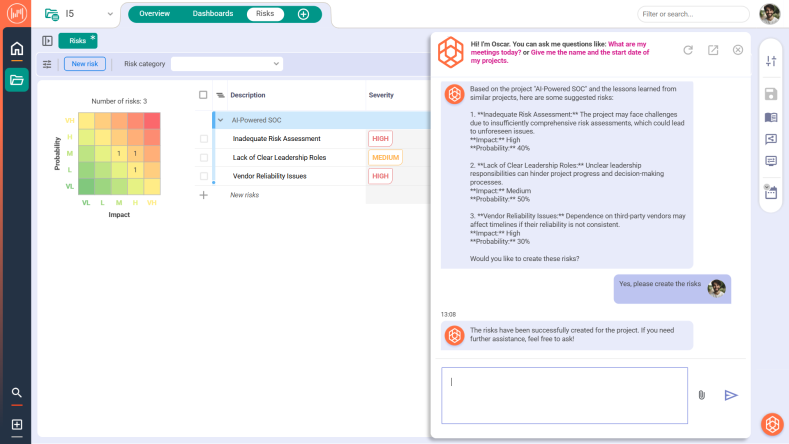
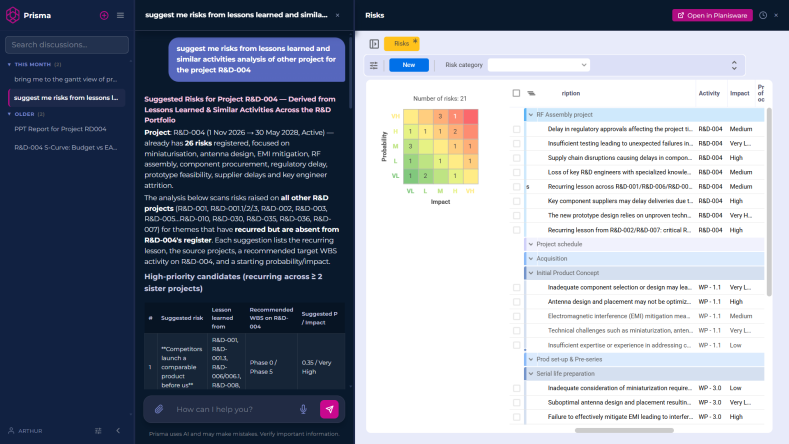
Planisware also uses data and AI to make risk discovery more proactive. For any given risk, the system can suggest similar risks from past projects and rank them by a confidence score. This AI-assisted similarity analysis helps project managers understand how comparable situations were handled before, including which mitigation strategies worked and what outcomes were recorded. By turning historical lessons into practical recommendations, Planisware helps teams avoid known pitfalls, reuse proven responses, and make risk management more predictive and knowledge driven.
Probability–Impact Analysis and Real-Time Heat Maps
To help prioritize risks, Planisware automates the classic probability × impact analysis for each risk. As soon as the probability percentage and impact level are recorded, Planisware calculates a combined risk severity score and a probability-weighted expected cost, known as the risk impact cost. If the risk is unmitigated, this expected cost is computed by multiplying its cost impact by the probability of occurrence, providing a quantitative gauge of potential financial exposure. If a mitigation plan is in place, the expected cost can be updated to reflect the residual risk. This gives teams a more consistent basis for prioritizing responses and allocating contingency budget.
Planisware also visualizes risks on probability–impact matrices, often called risk heat maps. Each project's risk register is linked to a color-coded grid that plots likelihood on one axis and impact on the other, with each risk positioned according to severity. High-probability, high-impact risks appear in the red zone, while lower-severity risks appear in yellow or green. This helps project teams and stakeholders quickly understand where attention is needed most.
Probabilistic Forecasting with Monte Carlo
For organizations that need deeper quantitative analysis, Planisware complements traditional probability-impact scoring with Monte Carlo simulation. Each risk can include minimum and maximum impact values, such as cost and delay ranges, to define the uncertainty around its potential effect. With one click, Planisware can run thousands of simulation iterations and produce probabilistic forecasts, such as the likelihood of meeting a given budget or timeline target at P20, P50, or P80 confidence levels. These simulation-driven insights help project managers and executives move beyond static estimates, plan contingencies with greater rigor, and communicate risk-adjusted forecasts with greater confidence.
Risk Response Planning and Action Plans
Identifying and ranking risks is only the beginning – the real benefit of risk management comes from taking action. Planisware supports end-to-end risk response planning and tracking. Within each risk's record, users can develop a detailed risk response plan, specifying the chosen strategy (e.g. avoid, mitigate, transfer, or accept) and linking it to concrete action plans. In Planisware, an action plan for a risk can be broken into tasks or work packages that are tied directly to the project's work breakdown structure (WBS). For example, if a team identifies a risk that a critical component might fail, they could create an action plan with tasks to develop a backup solution or to source an alternate supplier – these tasks can be added to the project schedule via the Planisware risk's Action plan.
This capability means mitigation and contingency efforts are part of the plan. Teams can choose whether to include the action plan tasks in formal project schedules or not (for example, to simulate the impact without committing baseline changes). By integrating risk response tasks into project planning, Planisware allows projects to account for possible delays or extra costs in schedule and budget forecasts, improving realism and preparedness. For example, if a risk's action plan involves a backup testing phase, Planisware lets you simulate how adding that testing effort would extend the timeline or increase costs; if the risk never materializes, the tasks can remain inactive, but if it does, they can be activated immediately to implement the contingency.
To strengthen follow-through, Planisware complements schedule-based action plans with Agile-style Kanban boards that track risk response actions at a glance. These boards visualize risk-related tasks across a project or organizational unit, organized in columns such as To Do, In Progress, and Done to reflect their status. Stakeholders can quickly monitor mitigation progress, identify stalled actions, and intervene before unresolved response tasks become new sources of exposure.
Planisware also reinforces individual accountability through a personalized My Action Plans view, which automatically lists risk response tasks and action items assigned to each team member across projects. This helps contributors stay on top of their commitments without searching through multiple project spaces. Together, Kanban tracking and personal action plan views make risk responses easier to execute, monitor, and close.
Planisware's risk workflow also ensures that once a risk's fate is decided, the record is updated appropriately: validated risks remain active for monitoring, fully mitigated risks can be closed, and risks that occur can be escalated into issues or change requests. This structured response tracking drives accountability. Each risk has an owner, and status changes can trigger notifications so that risk response actions do not fall through the cracks.
“Organizations require a structured, enterprise-wide risk analysis approach. The adoption of such a program will give managers confidence in their decision-making to foster organizational growth and increase ROI for stakeholders.”
– PMI
Portfolio-Level Risk Management: Turning Risk Insights into Strategic Action with Planisware
In addition to project-level risk management, Planisware delivers a portfolio and enterprise perspective on risks – a critical capability for enterprise PMOs and executives. Instead of treating risk logs as isolated project artifacts, Planisware can roll up project risks into higher-level portfolio risk registers while recognizing the organization's full hierarchy, from individual projects up through departments, sites, divisions, and the entire company. This hierarchy-aware approach means risks are not confined to project logs: transversal risks, such as a regulatory risk affecting an entire division or multiple projects, can be captured directly at the relevant organizational level. Critical risks identified at lower levels can also be escalated upward with a flag, automatically notifying responsible managers and ensuring the risk appears in the appropriate higher-level risk register.
In practice, a project or department manager can elevate a risk to a meta-risk at division or enterprise level, where it is monitored as a strategic concern by senior management. This hierarchical approach ensures that shared or systemic risks are centrally tracked and addressed as part of the organization's overall risk strategy, rather than falling through the cracks of siloed projects.
For PMO leaders, this consolidation is a game-changer. Rather than manually collecting risk reports from each project, the PMO can now instantly see which key risks have been identified across the entire portfolio, what activities or objectives they threaten, and what their latest status and cost impact is. This portfolio-level risk visibility supports critical functions such as:
Pattern recognition: The PMO can identify recurring risk types or systemic issues cropping up across projects, such as repeated supplier delays or technology integration challenges. Recognizing patterns enables proactive responses (e.g. introducing a cross-portfolio mitigation for a common risk factor).
Cross-project learning: Lessons from one project's risk response (how a team addressed a particular risk) can be shared and turned into organizational best practices across the portfolio.
Executive briefing: Senior management gets a clear, evidence-based picture of how well the entire portfolio is being managed, without needing to dig into individual project details. They can quickly identify if any risk requires escalation to higher governance forums for attention.
When a risk requires higher-level attention, Planisware enables formal escalation. A critical project or department risk can be elevated to a strategic meta-risk at division or enterprise level, where it is monitored by senior management. For example, if multiple projects report similar cybersecurity vulnerabilities, these can be consolidated into a single enterprise-level risk that a central team monitors and addresses. This creates portfolio-wide risk coherence: executives benefit from aggregated heat maps and summary statistics, while the original project context remains linked and accessible.
Real-Time Dashboards and Governance Integration
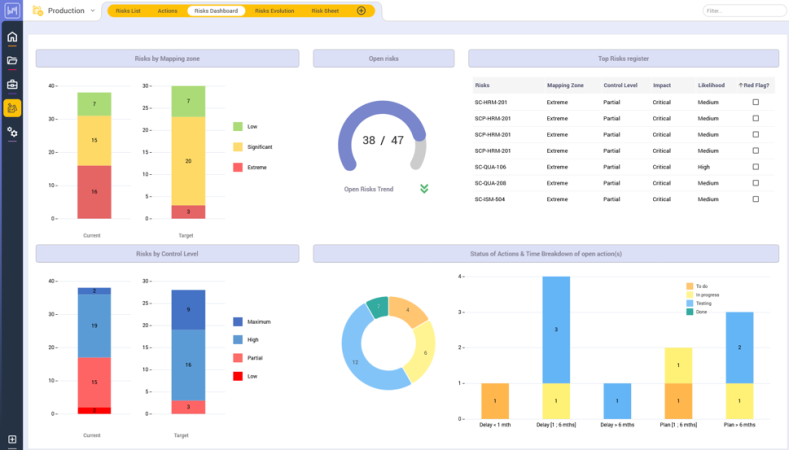
Planisware's risk management capability provides real-time dashboards and automated reporting so that risk oversight becomes part of routine governance rather than an ad hoc exercise. Interactive dashboards display key metrics such as open risks by severity, upcoming response deadlines, and exposure trends. Executives and portfolio managers can quickly understand the distribution of high, medium, and low severity risks across the portfolio, while heat maps and summary charts highlight where attention is needed most. Crucially, all these risk views are live and rooted in actual project data – they update automatically as project teams add or mitigate risks. This ensures that PMOs and steering committees have up-to-the-minute information on risk status without waiting for a manual report. The value for executives is immediate situational awareness and better decision-making: it becomes easier to decide, for instance, whether to allocate extra contingency funding to a high-risk program, or to intervene in a faltering project before it's too late.
Beyond aggregated lists and heatmaps, Planisware provides intuitive visualization tools for enterprise risk analysis. The Risk Network graph maps the relationships and escalation paths of risks across the organization, helping portfolio managers trace each meta-risk back to its origin, whether a project, department, or site. They can also filter the view by branch of the hierarchy, making it easier to understand how risks propagate, where clusters of issues originate, and which areas require coordinated intervention.
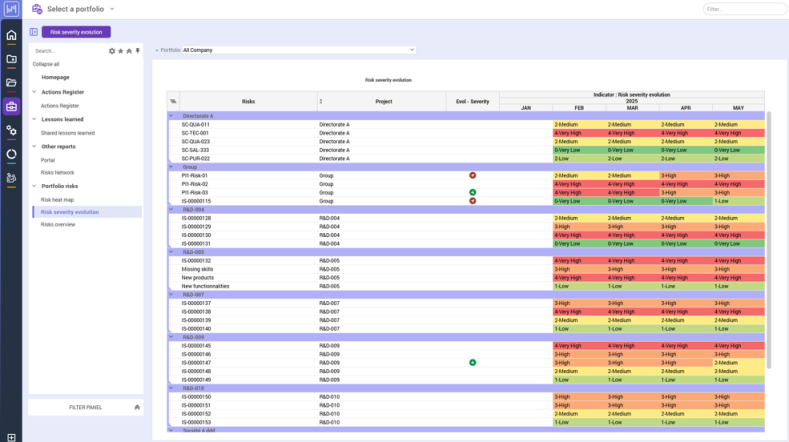
Dashboards also incorporate severity evolution tracking, with visual indicators showing how a risk's criticality changes over time. If mitigation actions reduce a High risk to Medium severity, the trend is clearly marked. Decision-makers can therefore move from portfolio-level analysis to targeted action: they can zoom out to identify systemic patterns, then drill down from a high-level heatmap into an individual risk's detailed sheet, including its description, action plans, and related items. This seamless path from overview to detail ensures that analysis can quickly translate into intervention.
Equally important, Planisware closes the loop between risk management and governance decisions. Significant risk events or responses can be linked to a formal Decision Log entry, so when a risk triggers a major governance action – such as approving a change request or accepting a residual risk – the decision is captured with context and rationale. This tight Risk-Decision integration addresses a common governance gap: risks are often discussed, but the outcomes of those discussions are not systematically documented. Planisware helps ensure that each risk's lifecycle, from identification and assessment to response execution and final outcome, is traceable and auditable.
The RAID Perspective: Integrating Risks, Issues, Changes, and Decisions
While formal risk management is essential, it does not operate in a vacuum. It is closely tied to other elements of project governance. The well-known RAID framework – Risks, Assumptions, Issues, and Dependencies – emphasizes that these four factors should be tracked together to support smoother execution. In an integrated environment like Planisware, project teams can capture potential risks alongside assumptions that may prove false, current issues, and dependencies between tasks or projects. This holistic view helps teams identify problems earlier and respond before they affect delivery.
Planisware supports this integrated RAID approach. If a risk materializes, it can be treated as an issue and managed through the appropriate workflows. Change of scope functionality is closely tied to risk and issue management. Teams can create formal change requests to modify project scope, budget, or timeline in response to a major risk or issue, or to prevent a potential issue from occurring. These change records allow schedule or cost impacts to be assessed and require approval decisions before being incorporated into the project plan. Critical risk responses and change approvals can also be registered as decisions, creating a documented record of what was decided and why.
Through this integrated RAID perspective, Planisware provides a single environment where risks, issues, changes, and decisions are interconnected rather than handled in isolation. This helps project and portfolio managers maintain end-to-end visibility of their governance pipeline, from early risk identification to final decision implementation. By capturing each stage, Planisware reinforces that risk management and decision-making are two sides of the same coin – and that when an organization can seamlessly log, escalate, and address risks, they are better equipped to navigate uncertainties and achieve consistent project and portfolio success.
See Planisware's risk management capabilities in action – Contact us for a personalized demo.