
Investment maturity is not a score. It helps organizations understand how their current situation, business priorities and delivery constraints are translated into better investment decisions, and where Valoris can create value from the next step in their journey.
Every organization already has investments, budgets and planning processes. The challenge is not to start from scratch, but to connect these elements into a coherent, evidence-based decision-making process that improves value, reduces risk and increases confidence in every investment choice.
Investment maturity is a journey, not a destination. Organizations create value at every stage by improving how they translate their current situation, business priorities and delivery constraints into better investment decisions. The purpose of this assessment is to identify what capabilities Valoris can bring today and the next opportunity to improve investment outcomes.
Wherever you start, Valoris helps you create value from your next investment decision.
Why assess your investment maturity?
No two organizations start from the same place, and that is not a problem to fix. Investment maturity is a journey, not a destination, and every stage of that journey already creates value.
The purpose of assessing your maturity is not to assign a score or a grade. It is to understand how your organization actually makes investment decisions today, and to identify the single most valuable improvement you can make next.
You do not need advanced maturity to begin. What matters is knowing your real starting point, so you can align five things to it: your data, your processes, your governance, your organization and your technology. Wherever you start, the goal is the same: create more value from your next investment decision.
The six investment maturity levels, one continuous journey
The investment maturity model describes six levels in one continuous journey, from project prioritization to enterprise-wide value optimization.
Levels 1–3 strengthen how organizations prioritize, value and optimize investment portfolios based on proposed projects, budgets and delivery constraints. From Level 4 onward, investment demand becomes increasingly informed by the asset base itself: asset condition, criticality, lifecycle needs, risk and reliability.
Image
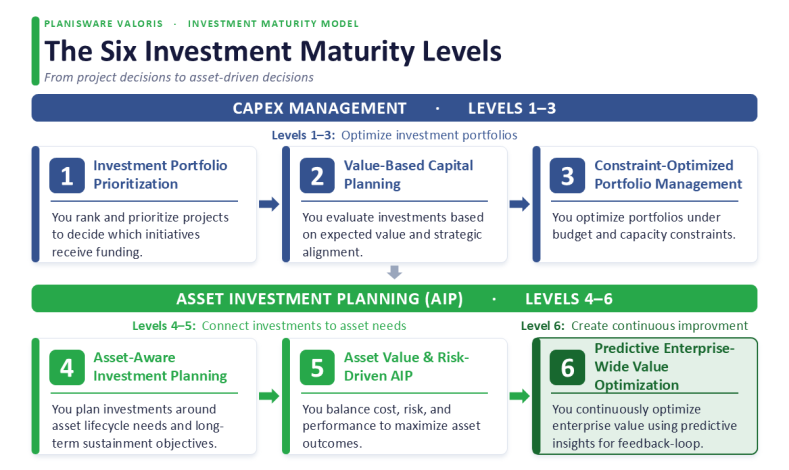
The transition matters because large CAPEX-intensive organizations usually arbitrate annual investment across sustainment, development, risk and compliance, performance, transformation and ESG. As maturity increases, investment planning becomes more connected to the asset base: asset age, health, criticality, lifecycle needs and sustainment policies progressively inform decisions, while advanced practices can also model how other investment categories affect asset capacity, performance trajectories and strategic objectives.
Where do you stand? A quick self-assessment
The fastest way to locate yourself is to read the statements below. Five “we…” statements describe each level.
Read from Level 1 upward: your current level is the last one where the statements still describe your organization. The point where they stop being true marks your frontier, and your next source of value.
Level 1: Investment Portfolio Prioritization
- We prioritize projects with a scorecard or ranking, mostly in spreadsheets.
- Our capital budget is visible, but it is hard to explain why one project outranks another.
- Decisions rely on business-unit judgment and negotiation more than shared evidence.
- We have a project list, but there is no consistent framework to evaluate projects against common organizational objectives.
- When budgets are cut, we defer projects reactively instead of re-optimizing the portfolio.
Level 2: Value-Based Capital Planning
- Every major investment needs a business case with ROI or NPV before approval.
- We evaluate projects on the value they create, not just cost or urgency.
- We track expected benefits but rarely measure whether the anticipated outcomes and value were realized.
- Our financial models are strong but remain focused on individual projects. They do not fully capture portfolio-wide trade-offs or long-term consequences.
- Investment decisions are typically made through annual planning cycles, with limited ability to adapt portfolios as business conditions evolve.
Level 3: Constraint-Optimized Portfolio Management
- We evaluate multiple investment scenarios to understand the impact of funding, resource, and delivery constraints.
- We make explicit trade-offs between competing investment opportunities to maximize portfolio value.
- We can rapidly assess and re-optimize the portfolio when priorities, budgets, or resource availability change.
- Our investment portfolio is aligned with strategic priorities and measurable business outcomes.
- We optimize the project portfolio, but investment decisions are still driven by projects rather than by the needs of the underlying assets.
PROJECT-CENTRIC → ASSET-CENTRIC
Level 4: Asset-Aware Investment Planning
- We leverage asset inventory data (age, class, criticality) to guide sustainment investment decisions.
- We plan sustainment projects over 5–30 years, not just the next budget cycle.
- We define sustainment strategies by asset class (maintain, renew, replace, etc.).
- Projects are linked to the underlying assets they affect, with their expected impact on asset conditions.
- We assess the impact of investment portfolios on asset lifecycle costs, asset age evolution, and depreciation, but do not yet incorporate quantified failure risk into decision-making.
Level 5: Asset Value & Risk-Driven AIP
- We model asset degradation and failure probability, not just age.
- We can prioritize project launch based on risk = likelihood × consequence, across the fleet.
- We balance cost, risk and performance explicitly when we choose what to fund.
- Mandatory, safety- and regulation-driven work is protected in the portfolio.
- We can show how each investment changes the fleet’s risk and availability trajectory.
Level 6: Predictive Enterprise-Wide Value Optimization
- We optimize investments across the whole enterprise (multiple portfolios, regions, and asset classes) while balancing budget, resource capacity, and outage window constraints in a single enterprise-wide simulation.
- We run simulations (Monte Carlo, sensitivity, efficient frontier) to test decisions under uncertainty.
- AI helps generate, score and optimize scenarios and recommend trade-offs.
- Predictive models continuously refine project assumptions and expected outcomes based on historical performance and execution data.
- ESG objectives, climate resilience, and regulatory commitments are embedded within our strategic objectives framework and systematically incorporated into scenario evaluation and investment decisions.
Wherever the statements stopped being true, that gap is not a verdict. It is your next source of value, and the focus of the Investment Maturity Guide.
How Valoris meets your organization where it is
Planisware Valoris was designed around a simple principle: you should not need perfect maturity to start creating value.
Planisware Valoris is designed as a strategic decision layer for investment planning. It complements existing EAM, APM, ERP and PPM systems by connecting asset management, investment planning and portfolio execution into a progressively more mature decision process.
Wherever an organization starts, Valoris helps create value at the current maturity level while preparing the next step:
- at Level 1, creating a governed intake and prioritization process so investment requests, budgets and ranking logic are visible and defensible;
- at Levels 2–3, strengthening business cases, value measures, scenario comparison, constraint-aware optimization and in-year portfolio steering;
- from Level 4 onward, connecting asset inventory, lifecycle needs, risk, reliability and execution feedback to investment scenarios and enterprise-wide value optimization.
The objective is not to reach the highest maturity level as quickly as possible. It is to create value now, improve investment confidence, and build a practical roadmap from project-led decisions toward asset-informed, and eventually predictive enterprise-wide, value optimization.
Assess your maturity, then take the next step
Maturity is not the destination. Better investment decisions are. And every organization, wherever it starts, can create more value from its next one.
The Investment Maturity Guide helps you turn this journey into action. Inside, you will:
- confirm your current maturity level across the six levels;
- identify the next opportunity to improve investment outcomes across data, processes, governance, organization and technology;
- see which Valoris capabilities can create value today at each maturity level;
- and understand how to progressively connect asset strategy, investment planning, portfolio optimization and execution readiness.
Found your level? See what to do next.
Download the guide to confirm your investment maturity profile, identify your next source of value, and see how Valoris helps connect investment planning, asset insights and portfolio execution into better decisions. Wherever you start, Valoris helps you create value from your next investment decision.
Download the Investment Maturity Guide (available at the top of the page)
Prefer to talk it through? Assess your investment maturity with a Planisware Valoris expert.



![[illustration] earned value management article](/sites/default/files/styles/teaser_grid/public/2026-09/article-hero-financial-gauge.png?h=197483aa&itok=VjXFYXw-)
![[illustration] AIP off spreadsheets](/sites/default/files/styles/teaser_grid/public/2026-09/move-capital-planning-off-spreadsheets.png?h=197483aa&itok=SYpmljtm)