Scaling Scrum beyond a single team changes coordination, dependencies and governance for a Project Management Office (PMO). When Scrum works at the team level, organizations want to extend its benefits across programs and portfolios. Those benefits include frequent releases, continuous feedback and cross-functional ownership. The move from 1 team to many creates coordination challenges, dependency risks and governance questions that single-team Scrum never had to answer. This playbook gives PMO leaders a structured, comparative evaluation of frameworks, governance models and implementation approaches. Use it to match the right path to your organization's size, maturity and strategic context.
Most organisations have a strategy. Far fewer can prove that their funded work is advancing it. The gap between strategic ambition and operational delivery is where value leaks. OKR software, embedded inside a strategic portfolio management (SPM) platform, is designed to close that gap.
Microsoft Project Online retirement is prompting organizations to make important decisions about what comes next. The challenge isn't simply replacing a tool.
Most organisations treat go-live as the finish line. It is the starting line for embedding strategic portfolio management into the operating model. Modern enterprise PMOs are shifting from command-and-control compliance to enablement and decision support. The weeks and months after launch determine whether that shift sticks.
Enterprise Project Management Offices (PMOs) rarely operate in a single-methodology world. Most portfolios blend stage-gate programs with sprint-based product development.
Enterprise PMOs in asset-intensive industries face a familiar tension. Capital expenditure decisions carry more variables every year, yet many organizations still manage them through spreadsheets passed between inboxes.
Enterprise Project Management Offices (PMOs) are under mounting pressure to fund the right initiatives, not simply to complete projects on time. Product planning tools have evolved beyond status-reporting dashboards into strategic decision-support systems. The platform you choose determines whether your PMO can bridge the gap between vision and execution.
Prioritising product development initiatives is one of the most consequential responsibilities of an enterprise Project Management Office (PMO). It is also one of the most frequently mishandled.
Portfolio managers face tighter regulatory scrutiny, constrained resources and constant pressure to prove that every investment advances strategy. Governance and compliance tools have moved from back-office necessities to operational platforms.
Every product begins as an idea, a hypothesis about a problem worth solving. The challenge is turning that idea into a plan the organization can rally behind, resource properly and deliver on time.
Every enterprise portfolio faces the same structural tension. The business wants to execute more than its people, budget and time can absorb. Left unmanaged, the gap between demand and capacity erodes strategic focus, overburdens teams and reduces return on investment.
Enterprise Project Management Offices (PMOs) must select AI-powered Strategic Portfolio Management (SPM) software carefully. The market has matured, and platforms increasingly embed AI in core decision workflows rather than adding it later.
Horizon is the Strategic Portfolio Management platform purpose-built for IT and digital business teams. It helps prioritize programs,
projects and initiatives to optimize ROI, while giving your digital and IT landscape a competitive advantage.
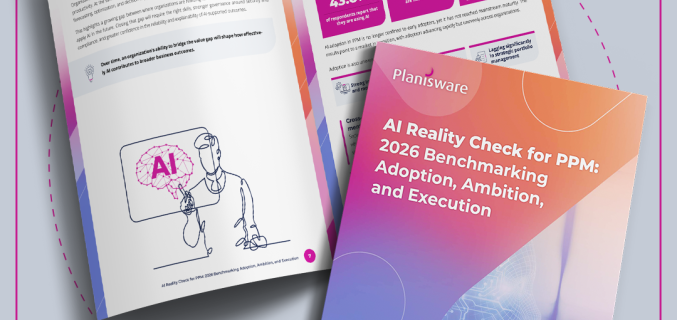
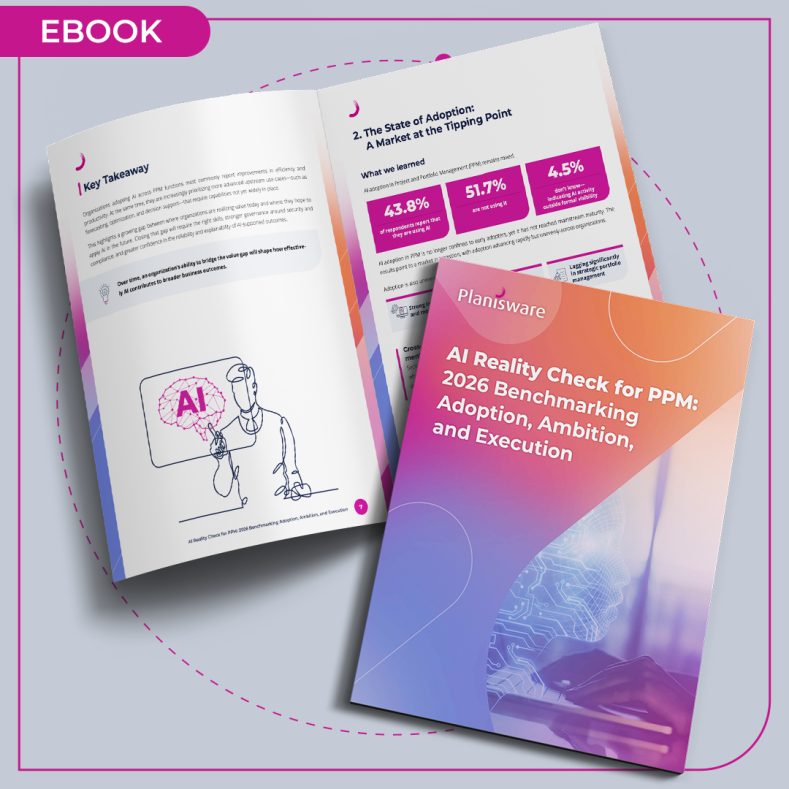
As artificial intelligence continues to transform project and portfolio management practices, we wanted to understand how the growing interest in AI is actually translating into action within organizations. This study was designed to separate perception from reality and provide you with a practical benchmark to assess your level of maturity against your peers.





![[illustration] portfolio optimization](/sites/default/files/styles/media_large/public/2026-08/cloud-ai-ppm-portfolio-optimization.png?h=197483aa&itok=5FjsoWVE)
![[illustration] portfolio optimization](/sites/default/files/styles/max_789_x789/public/2026-08/cloud-ai-ppm-portfolio-optimization.png?h=197483aa&itok=NGBb1JbZ)


![[illustration] earned value management article](/sites/default/files/styles/media_large/public/2026-09/article-hero-financial-gauge.png?h=197483aa&itok=wp5aouTU)
![[illustration] earned value management article](/sites/default/files/styles/max_789_x789/public/2026-09/article-hero-financial-gauge.png?h=197483aa&itok=IhVzQDOy)
![[illustration] AIP off spreadsheets](/sites/default/files/styles/media_large/public/2026-09/move-capital-planning-off-spreadsheets.png?h=197483aa&itok=vBPIE9pH)
![[illustration] AIP off spreadsheets](/sites/default/files/styles/max_789_x789/public/2026-09/move-capital-planning-off-spreadsheets.png?h=197483aa&itok=NZU5ycir)



![[Illustration] Gouvernance CAPEX](/sites/default/files/styles/media_large/public/2026-08/logiciels-gestion-gouvernance-capex.png?h=197483aa&itok=269-JPhw)
![[Illustration] Gouvernance CAPEX](/sites/default/files/styles/max_789_x789/public/2026-08/logiciels-gestion-gouvernance-capex.png?h=197483aa&itok=JswDegOt)



![[illustration] centralized project oversight](/sites/default/files/styles/media_large/public/2026-09/centralized-project-oversight-platform.png?h=197483aa&itok=cig_Yr-L)
![[illustration] centralized project oversight](/sites/default/files/styles/max_789_x789/public/2026-09/centralized-project-oversight-platform.png?h=197483aa&itok=4ZuC7DU7)



![[illustration] customer success](/sites/default/files/styles/media_large/public/2026-09/article-hero-handshake%20%281%29.png?h=197483aa&itok=0mEHzJEO)
![[illustration] customer success](/sites/default/files/styles/max_789_x789/public/2026-09/article-hero-handshake%20%281%29.png?h=197483aa&itok=6Nf8zd7B)