Portfolio directors face more funding requests than they can ever approve, and the information needed to choose between them is spread across strategic themes, OKRs, project plans and market reports. Seeing how each pillar is progressing, whether the scope still reflects where the market is heading and which projects actually move the objectives forward takes days of analysis, so investment decisions are often made on partial information.
Planisware Prisma helps portfolio directors connect strategic themes, OKRs and investments, giving them a clear view of where resources create the greatest value and how to make better portfolio decisions.
Let's follow a portfolio director as they use Prisma to review the strategic pillars, challenge the scope of one of them and decide where to invest next.
From strategy to investment decisions with Prisma
Get a clear view of every strategic pillar
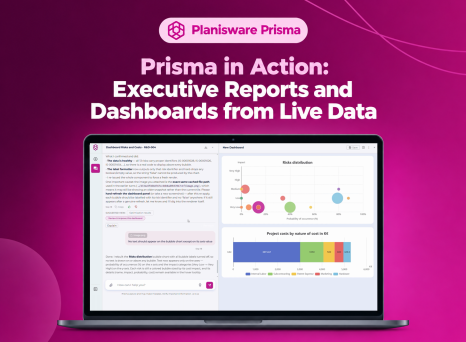
The director asks Prisma to summarize the scope and advancement of each strategic pillar. Prisma returns a structured overview of Innovate, Grow and Run, showing the projects, total budget, schedule window and average progress of each. It then draws out cross-pillar takeaways: advancement is coherent with the strategy, budget is concentrated on Grow rather than on innovation, and six projects are still at 0% progress. In a single request, the director gets a portfolio-wide picture that would otherwise take days to consolidate, along with the signals that deserve attention first.
Test the scope against market intelligence
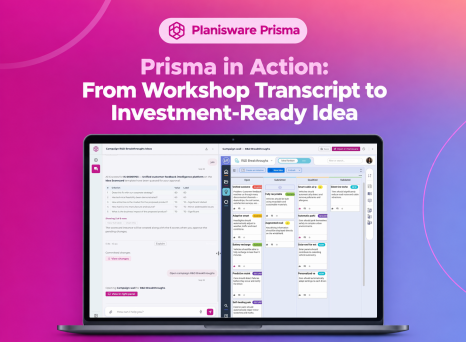
Next, the director attaches a technology-watch report on connected smart devices and asks what could be improved in the scope of the High Tech Products pillar. Prisma compares the report's themes with the pillar's ten projects and produces a gap analysis. For each missing theme, it suggests an action, such as a cybersecurity program, an interoperability and standards initiative or a responsible AI governance track. It also flags housekeeping issues, like a completed project still marked as a simulation, before proposing a reshaped pillar. Instead of sitting in a separate report, market intelligence turns into concrete scope decisions, helping the portfolio keep pace with where the market is heading.
Check that OKRs match the scope
The director then asks whether the pillar's OKRs are coherent with its scope. Prisma finds that one objective is well supported, while "Build Recurring Software Revenue Stream" has no project contributing to it at all. It also points out key results with outdated targets or missing completion dates and lists the recommended fixes in order of priority. Catching an unsupported objective this early means it can be fixed before it becomes a missed target, and every OKR stays backed by real delivery.
Decide where to invest
To move the under-supported objective forward, the director asks which projects or initiatives to prioritize. Prisma ranks the candidates and explains why each one fits and which key result it should own. It also identifies supporting projects and names those that should stay focused on their current objective. Each recommendation comes with its reasoning, so the director can defend investment choices and act on them straight away.
See the impact on the portfolio
In the portfolio scenario view, the director adds two of the initiatives Prisma identified to the scenario, and once the change is saved, the dashboard updates. The recurring revenue key result moves from at risk at 66% to on track at 101%, the number of OKRs attained rises from zero to three, and the scenario's total NPV grows from $19.1M to $30.6M. Seeing the effect on objectives, cost and value before committing gives the director the evidence needed to back each investment decision.
What Prisma brings to portfolio teams
- Get an instant, structured view of every strategic pillar, including scope, budget, schedule and progress.
- Bring external market intelligence into portfolio reviews and turn it into concrete scope recommendations.
- Spot gaps between OKRs and the projects meant to deliver them before they turn into missed objectives.
- Prioritize investments with clear reasoning behind every recommendation.
- Keep portfolio data clean by surfacing outdated statuses, stale targets and misaligned dates.
- Test investment choices in scenarios and see their impact on OKRs, cost and NPV before committing.