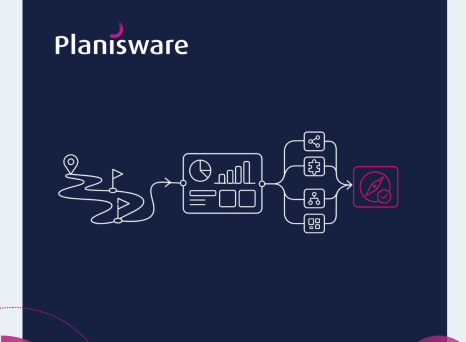
Strategic portfolio management helps organizations align resources, projects and goals with their strategic priorities to generate maximum value. It is about selecting and steering projects, programs and investments so that they support the corporate strategy as effectively as possible.
Modern Strategic Portfolio Management software (SPM software) ensures that initiatives stay continuously aligned with the central objectives and can be reprioritized when needed. In an environment of growing market change and rising data volumes, Planisware helps decision-makers implement strategies in a structured way and make well-founded decisions.
The combination of clear goal alignment, scenario modeling and AI-powered analytics forms the basis for optimizing portfolios sustainably and efficiently.
Technology-supported strategic portfolio management closes the gap between strategy and execution. With modern SPM software, organizations can operationalize strategies from data, identify risks early, accelerate investment decisions and continuously monitor budget adherence and return on investment (ROI).
Planisware is recognized as a Leader in the Forrester Wave for Strategic Portfolio Management. The platform brings strategic planning, roadmapping, scenario modeling, governance and performance tracking together in a scalable SaaS environment, tailored to organizations of any size and maturity level. Through AI-powered analytics and adaptive planning processes, Planisware creates the basis to implement strategic portfolio decisions measurably and sustainably.
Assess Your Maturity Level and Starting Point for Portfolio Optimization
The first step toward effective strategic portfolio optimization is taking stock of your own maturity level. Maturity in portfolio management refers to the degree to which processes, tools and roles are already formalized and actively practiced by the organization.
A simple assessment framework helps organizations gauge where they stand:
| Assessment Criterion | Entry Level | Advanced Level |
|---|---|---|
| Governance structure | Individual decision-makers | Clear roles and bodies defined |
| Data quality | Project-level data | Integrated, up-to-date enterprise data |
| Readiness for change | Ad hoc decisions | Systematic change management |
| Strategy integration | Strategies only partly mapped | Strategies fully integrated into portfolio planning |
A capable SPM software adapts to any maturity stage. Planisware offers a scalable framework that ranges from capturing basic metrics to advanced analytical evaluations, improving portfolio efficiency step by step.
Model the Strategy and Build a Clear Goal Hierarchy
Effective portfolio decisions rest on a clear goal hierarchy. By modeling strategic pillars, measurable goals (Objectives and Key Results, OKRs) and the associated key performance indicators (KPIs) in the software, organizations create a direct link between strategy and execution.
Example goal structure:
| Strategic Pillar | Goal (OKR) | KPI | Assigned Investments |
|---|---|---|---|
| Sustainability | CO₂ reduction of 20% by 2030 | Energy-efficiency projects | Green CAPEX portfolio |
| Innovation | Product launches +30% | Time-to-market | R&D programs |
This mapping enables a transparent assessment of each initiative in terms of its strategic contribution. The result is a sound basis for ROI analyses: across financial metrics as well as qualitative goals.
Centralize and Standardize the Intake Process for Requests
A central intake process ensures that ideas and business cases are collected, assessed and prioritized in a structured way. It forms the starting point for every portfolio.
An example flow:
- Submission of ideas and initiatives: employees or teams submit proposals.
- Initial assessment: early review of feasibility and relevance.
- Scoring: evaluation against defined criteria, for example strategic contribution, risk or ESG impact.
- Business case development: detailed estimate of benefits and costs.
- Decision gate: validation and approval for inclusion in the portfolio.
Planisware supports each phase with configurable assessment models, dashboards and workflows. The entire process thus becomes transparent, comparable and traceable: a decisive factor for governance and buy-in across the organization.
Prioritize and Model Scenarios for Well-Founded Decisions
In strategic portfolio optimization, one rule applies: not everything can be done at once. Scenario modeling helps simulate different options for action and assess their effects on budget, risk or resources.
Scenario modeling is the model-based evaluation of multiple alternatives, in order to make decisions on a factual basis. Planisware enables real-time analyses and visual comparisons between scenarios: for example, how budget cuts or capacity shifts influence strategic value.
Interactive dashboards make it possible to compare different budget and resource scenarios, quantify risks and translate prioritized scenarios directly into implementation plans. Planisware also uses generative AI to test the assumptions in business cases and refine decision hypotheses.
Launch a Pilot Phase and Define KPIs for Lasting Success
A targeted pilot builds confidence in new processes. Organizations should start with a clearly delimited sub-portfolio and measure the impact against defined metrics:
| KPI | Description | Example Result After the Pilot |
|---|---|---|
| Budget adherence | Variance between planned and actual budget | +12% improved |
| Time-to-decision | Time between data collection and investment decision | -25% reduced |
| Strategic alignment | Share of projects with a direct goal link | +18% increased |
The goal: value validation, risk reduction and measurable improvements before the full rollout. Planisware supports these evaluation phases with clear KPI definitions and reporting mechanisms that make progress and impact visible.
Implement Scaling, Integration and Real-Time Dashboarding
After a successful pilot, the scaling of portfolio management to further areas and organizational units begins. A central prerequisite is the seamless integration with existing IT systems such as Jira, enterprise resource planning (ERP) or business intelligence (BI) platforms, to ensure consistent data flows. Planisware supports this through solutions such as the BI Box and Planisware Explorer.
Recommended practice:
- Role-based dashboards: distinct views for leadership, the PMO and project managers.
- Automated reporting: live analyses for budget, resource and goal-attainment data.
- Regular reviews: dashboards and governance meetings form the cycle of continuous optimization.
This close integration creates a reliable data basis as a single source of truth and strengthens decision-making at every level.
Improve Continuously Through Governance Reviews and Operational Monitoring Cycles
After implementation, long-term value creation begins. Governance reviews ensure that strategic alignment and performance are checked regularly. A governance review is a structured, recurring examination of the entire portfolio and its steering mechanisms.
Typical flow of a review cycle:
- Review KPIs
- Document insights
- Adjust governance
- Update the roadmap
A quarterly rhythm at the strategic level and monthly monitoring of operational KPIs foster continuous learning and durably improved results. Planisware provides reporting workflows for this that make governance cycles plannable and auditable.
Operationalize Financial Planning and Resource Steering with AI Support
SPM unfolds its full value when financial and resource planning can be steered in an integrated way. Planisware offers simulations for budget allocations, capacity forecasts and workload steering, all in real time.
AI-powered functions such as Planisware Oscar help teams build business cases, identify trends and validate options for action. A real-world example: TotalEnergies steers 2,300 engineers across 9 sites in 3 countries with Planisware, delivering portfolio results on time and within budget.
Organizations thus combine precise planning reliability with strategic agility.
Ensure Change Management and Stakeholder Engagement
Technology only brings lasting success when people actively support it. Change management encompasses all measures that promote acceptance, training and results monitoring.
Best-practice steps:
- Define roles (Portfolio Owner, PMO, business units)
- Establish a communication and training plan
- Set up feedback loops with end users
- Demonstrate proof of value through results measurement
Direct integrations, for example approvals via Microsoft Teams, ease real-time decisions and strengthen the engagement of all stakeholders. Planisware accompanies these processes with practical methodology and clear governance support.
In summary, strategic portfolio management enables organizations to make well-founded decisions, deploy resources optimally and implement their strategy in a measurable way.
Frequently Asked Questions on Strategic Portfolio Optimization
What Resources Can I Consult to Learn More About Strategic Portfolio Optimization with Planisware?
The following Planisware resources go deeper on the methods and tools covered in this article:
- Strategic Portfolio Management: the pillar page connecting strategy, execution and risk control.
- What Is Project Portfolio Management (PPM)?: the reference definition and foundation for any portfolio approach.
- How to Choose a Strategic Portfolio Tool and Avoid Common Pitfalls: selection criteria and implementation mistakes to avoid.
- 10 Proven Scenario Planning Tools: comparing alternative futures to secure decisions.
- The 8 PMO KPIs That Really Matter in 2026: a strategy-centric set of metrics for steering portfolios.
- Best Strategic Portfolio Management Software 2026: how to evaluate and compare SPM platforms.
- TotalEnergies: Making Portfolio Management Strategic: a real-world implementation story.
- Planisware Customer Stories: real-world results in strategic portfolio optimization.
What Is a Strategic Portfolio, and What Does Strategic Portfolio Management (SPM) Cover?
A strategic portfolio comprises all projects, programs and initiatives that are deliberately aligned with corporate goals and actively steered by their value contribution. Strategic Portfolio Management (SPM) is the discipline that connects this strategic ambition to operational execution.
In practice, SPM helps organizations to:
- select and prioritize investments by their strategic value;
- reallocate resources when priorities change;
- track performance against defined objectives.
This approach turns strategy into traceable, repeatable decisions. A project portfolio management (PPM) platform brings the data of strategy, resources and finances into a shared view for this purpose. The wider framework is set out on the strategic portfolio management page.
Which KPIs Help Steer a Strategic Portfolio?
A few key indicators are enough to make portfolio performance objective and to trigger decisions early. The examples below illustrate typical targets measured during a pilot:
| KPI | What It Measures |
|---|---|
| Budget adherence | Variance between planned and actual budget |
| Time-to-decision | Time between data collection and investment decision |
| Strategic alignment | Share of projects directly linked to a goal |
At the portfolio level, financial indicators such as ROI and net present value extend this view. Selecting the right metrics is part of choosing the right platform, as the guide on how to choose a strategic portfolio tool explains. With real-time reporting in Planisware, leaders track these signals dynamically and steer investment trade-offs.
What Role Does Scenario Modeling Play in Portfolio Optimization?
Scenario modeling lets you compare options for action and assess their effects on value, risk and capacity directly. It replaces gut-feel decisions with fact-based analysis.
In practice, an organization models several alternatives, for example a budget cut or a capacity shift, then compares their strategic impact before committing resources. Planisware visualizes these comparisons in real time and uses generative AI to test the assumptions in business cases. The method and tools are explored in the 10 proven scenario planning tools, and how to evaluate platforms in the guide to the best strategic portfolio management software.
How Do You Connect Corporate Strategy and the Project Portfolio Effectively?
The link is built through a clear cascade, from strategic pillars to concrete projects. Each initiative becomes traceable to a corporate priority.
- Strategic pillars: define the major axes (sustainability, innovation, growth).
- Measurable goals (OKRs): translate each axis into concrete targets.
- KPIs and investments: link each goal to indicators and projects.
With Planisware, corporate goals, OKRs and programs map directly onto projects and investments, and adjust continuously. This mapping makes the strategic contribution of each initiative visible and feeds ROI analyses. The strategic portfolio management page sets out the framework that sustains this alignment over time.
How Does SPM Software Like Planisware Support Optimization, and How Do You Get Started?
SPM software brings strategy, resources, finances and execution onto a single platform. This shared source of information makes portfolio decisions faster and better-founded. Getting started works in stages:
- assess the maturity level and starting point;
- launch a pilot on a clearly delimited sub-portfolio;
- scale up with integration, real-time dashboarding and governance reviews.
The value is demonstrable: TotalEnergies steers 2,300 engineers across 9 sites in 3 countries with Planisware, delivering on time and within budget. Recognized as a Leader in the Forrester Wave for Strategic Portfolio Management, Planisware is trusted by approximately 600 of the world's leading organizations. The criteria for choosing a tool are detailed in the guide on selecting a strategic planning and portfolio tool.