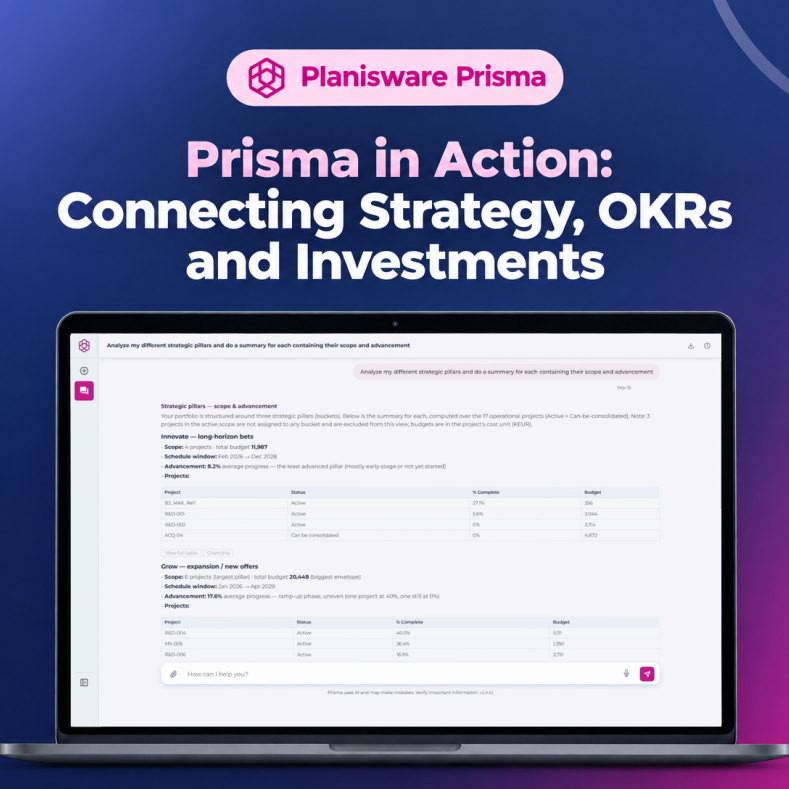
Portfolio directors face more funding requests than they can ever approve, and the information needed to choose between them is spread across strategic themes, OKRs, project plans and market rep
This article presents a practical framework to compare the financial value of projects by duration and risk. It helps leaders prioritize the portfolio for strategic impact.
Contract research organizations (CROs), clinical monitoring firms and biostatistics consultancies share a planning problem that spreadsheets were never built to solve.
Project controls software that integrates with ERP and scheduling systems lets enterprise PMOs keep the tools they already own. It adds a governance layer that connects cost, schedule and approvals in 1 auditable record.
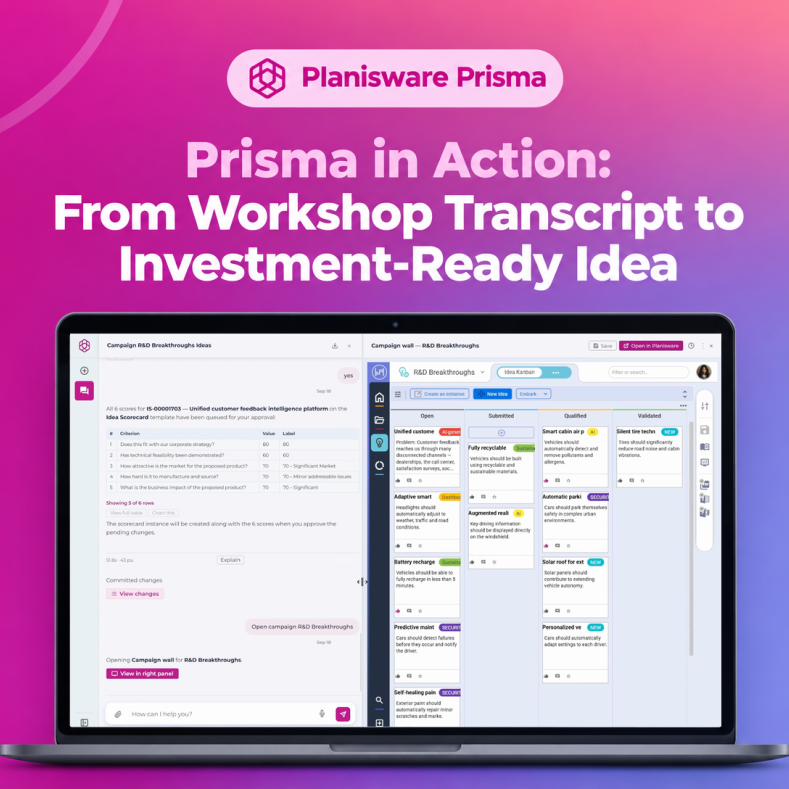
Innovation workshops surface valuable insights and promising ideas, but the hard part comes afterwards. The ideas live in long transcripts and scattered notes.
Enterprise product development demands more than task tracking and team collaboration. Your portfolio may span multi-year research and development (R&D) programs, regulated stage-gate processes and cross-functional engineering workstreams. At that scale, the software you choose must connect strategy to execution across the organization.
Product portfolio optimization is the practice of managing every product in an organization's lineup as a single governed investment. Enterprise Project Management Office (PMO) leaders evaluate each product's financial performance, strategic fit and resource demands. The goal is to maximize return on investment (ROI), remove redundancy and keep the portfolio aligned with changing business objectives.
Most transformation offices face the same problem. Dozens of change initiatives run across divisions, each tracked in its own spreadsheet, slide deck or point tool. No one sees the full picture.
Scaling Agile beyond individual teams requires tooling that connects strategic intent to delivery across every value stream. Lean portfolio management tools exist for this purpose.
When project requests arrive from 20 or more business departments, portfolio governance breaks down fast. Requests come in through emails, chat threads, hallway conversations and vendor-driven escalations.
If you lead IT in a service-oriented organization, your portfolio rarely looks like a textbook project list. You manage digital transformation programs, application support services, infrastructure upgrades and regulatory initiatives.
Project delays rarely announce themselves. They build quietly: an approval that lingers, a dependency nobody noticed, a specialist stretched across too many initiatives. By the time these issues reach a status meeting, the damage is already moving through the schedule.
Professional services automation (PSA) software unifies project delivery, resource management, time tracking, billing and client collaboration in a single operational platform. In 2026, the most capable PSA platforms embed AI-driven resource allocation. They match consultants to engagements, forecast capacity gaps and can execute staffing decisions without manual intervention.
Planisware, a leading provider of B2B AI-powered SaaS platforms serving the rapidly growing Project Economy, today announced a major expansion of its global partner strategy, including the establishment of a dedicated global partner organization and the launch of new partner programs.