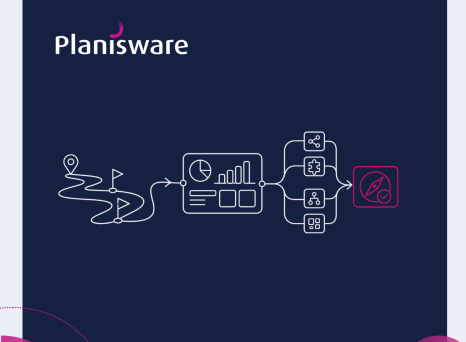
Modern enterprises ask: what platform helps with digital transformation planning? The right answer is a platform that connects strategy to execution across portfolios, integrates cleanly with your architecture, and scales with governance and security.
This guide distills how to evaluate, pilot, and adopt a digital transformation planning platform that advances enterprise digital strategy—linking objectives, funding, resources, and delivery with clear, outcome-focused measurement. Drawing on recognized frameworks and leading practices, it also highlights where AI-enabled decision support and secure, single-tenant cloud options like Planisware can reduce risk and accelerate value.
Understanding Digital Transformation Planning Platforms
A digital transformation planning platform is software that aligns enterprise strategy, operations, data, and technology to plan, govern, and execute cross-functional digital initiatives. It unifies roadmaps, portfolios, financials, resources, risks, and dependencies so leaders can prioritize investments, orchestrate change, and measure outcomes at scale.
Selecting a platform should start with your transformation framework, operating model, data architecture, and governance priorities—not a feature checklist. Enterprises that match platform capabilities to execution realities reduce complexity and avoid tool sprawl. In practice, low-code digital transformation tools can digitize manual processes to improve efficiency and compliance tracking, as shown by multiple real-world examples of rapid process modernization and automation in regulated contexts (see the Enterprisers Project’s real-world examples).
When platforms act as an integration platform across ERP, CRM, HR, analytics, and dev toolchains—and serve a well-defined enterprise digital strategy—organizations gain the agility to reprioritize, the visibility to steer, and the controls to grow with confidence.
Key Capabilities to Prioritize in a Digital Transformation Platform
Focus on capabilities that create measurable value and architectural leverage:
- Integration and API-first architecture
- Orchestrate, don’t replace, core systems through standards-based APIs and eventing.
- Support bi-directional data flows and enterprise integration patterns across ERP, CRM, HRIS, finance, and data platforms, reflecting leading practices for enterprise change.
- No-code/low-code tooling
- Accelerate delivery with visual configuration, templates, and guardrails that enable business-IT collaboration.
- Promote reuse and standardization without sacrificing governance.
- Unified data foundation (data cloud/lake)
- Merge structured and unstructured data for analytics, observability, and AI enablement.
- Support lineage, quality, and policy enforcement across domains.
- Configurable governance, compliance, and security
- Map to global/regional requirements (e.g., GDPR, SOC 2) with role-based access, approvals, audit trails, and policy-as-configuration.
- Scale controls across business units and geographies.
Concise definitions:
- API-first architecture: Designing platforms with standardized, stable APIs as the backbone, ensuring seamless, secure integration among diverse enterprise systems and enabling modular evolution without costly rewrites.
- Low-code/no-code: Development approaches that use visual interfaces and prebuilt components to build applications rapidly, minimizing hand-coding and improving collaboration between business and IT.
Signals to look for:
- Native connectors and event streaming; robust SDKs; versioned APIs
- Visual workflow/orchestration; guardrailed citizen development
- Data lakehouse compatibility; lineage and quality services; AI/ML hooks
- Policy-driven access models; encryption, SSO/MFA; auditable workflows
Planisware perspective: Planisware’s strategic portfolio management unifies scenario planning, funding, and capacity with AI-enabled decision support, while its single-tenant cloud and granular data controls help large enterprises scale with security and sovereignty.
Aligning Your Transformation Framework and Business Objectives
A singular, well-understood framework anchors platform selection and prevents fragmentation. Common approaches include:
- Strategy-first: Start with outcomes and value pools; backcast roadmaps and funding.
- Capability-driven: Prioritize capability gaps; sequence initiatives to build reusable capabilities.
- Phased scaling: Pilot, learn, and progressively industrialize across units and regions.
- Customer-centric: Design around journeys; optimize end-to-end value and experience.
A digital transformation framework is a structured model that connects business vision to execution through defined stages, governance, funding, capability building, and metrics. Widely referenced models such as McKinsey’s staged transformations and BCG’s phased approach emphasize clarity of objectives, governance, and iteration (see this overview of transformation frameworks).
Pick one framework and stick to it. Converging on a single model clarifies scope, speeds decisions, and aligns measurement, reflecting best practices highlighted by leading consultancies.
Framework comparison
| Framework | Best for | Typical stages | Primary benefits |
|---|---|---|---|
| Strategy-first | Enterprises pursuing value pools | Define value → Align funding → Execute | Clear ROI focus; portfolio alignment |
| Capability-driven | Complex orgs with shared services | Assess gaps → Build → Scale reuse | Reuse, standardization, faster time-to-value |
| Phased scaling | Highly regulated or diversified firms | Pilot → Industrialize → Globalize | Risk-managed scaling; change adoption |
| Customer-centric | B2C/B2B2C and service-led orgs | Journey map → Redesign → Optimize | Experience-led growth; NPS and retention gains |
Mapping System Integrations and Data Architecture Needs
Map integrations deliberately to orchestrate existing business processes:
- List critical systems by domain: ERP, finance, CRM, CPQ, commerce, PLM/ALM, HRIS, ITSM, data platforms, analytics/BI, identity.
- Document interfaces, data owners, refresh cadence, and event triggers.
- Define canonical data and semantic mappings for cross-portfolio reporting.
- Prioritize integrations that unlock end-to-end visibility (e.g., strategy-to-funding, idea-to-value, order-to-cash).
Unifying data in a governed cloud or lake improves analytics, observability, and AI-readiness by consolidating structured and unstructured sources under common policies and quality controls— a leading practice for enterprise transformations.
Snippet: API-first platforms paired with a centralized data cloud enable real-time visibility and agile reporting by streaming events from core systems into a shared semantic layer. Leaders gain up-to-date portfolio health, capacity, and financials—accelerating decisions and shortening feedback loops.
Evaluating Platform Vendors and Architecture Fit
Structure your platform evaluation to reduce risk and bias:
- Identify must-haves over features: Integration depth, API maturity, data architecture fit, governance, security, scalability, and AI enablement.
- Validate with specific use cases: Real-time onboarding, claims processing, and large-scale content automation are strong litmus tests for orchestration, compliance, and scale (see these real-world transformation examples).
- Build a platform evaluation matrix (RFP) that scores scalability, native integration support, modularity, configurability, and vertical expertise. Create a vendor shortlist based on architecture fit and proof from adjacent industries.
Key questions to include in a digital transformation RFP:
- How does the platform handle 10k+ projects/initiatives and multi-entity rollups without latency?
- What native connectors, API throughput, and eventing models are provided?
- How are governance, audit, and policy changes implemented and versioned?
- What are data residency options, tenancy models, and encryption controls?
Planisware fit: Planisware bridges strategy and execution for complex portfolios with AI-powered scenario planning and resource optimization, backed by a secure single-tenant cloud and granular data control—well-suited for global PMOs and IT strategy leaders.
Running Effective Pilots and Measuring Success
Checklist for targeted pilots:
- Select 1–2 high-impact workflows (e.g., funding approval, demand intake).
- Integrate essential systems; restrict scope to prove orchestration.
- Define KPIs: cycle time, throughput, compliance rate, defect rate, customer NPS, and adoption.
- Train pilot users, capture feedback weekly, and iterate configurations.
- Report outcomes and lessons; decide on phased rollout.
A digital transformation pilot is a time-boxed, real-world test of prioritized workflows that proves architectural fit, validates user experience, and measures value against predefined KPIs. It de-risks vendor selection, exposes integration and governance gaps, and informs scalable rollout planning.
Sample pilot KPI table
| KPI | Baseline | Target | Measurement approach |
|---|---|---|---|
| Funding approval cycle | 20 days | ≤7 days | Workflow timestamps across request-to-approve |
| Compliance exceptions | 8% | ≤2% | Automated checks and audit logs |
| NPS (internal stakeholders) | 20 | ≥40 | Post-release surveys |
| Rework rate | 15% | ≤5% | Defect tracking and change logs |
Establishing Governance, Training, and Continuous Improvement
Strong governance sustains momentum and ROI:
- Create a cross-functional steering committee, define decision rights, and run quarterly portfolio reviews tied to strategic objectives and value delivery.
- Standardize intake, prioritization, and funding gates; publish policies in the platform.
- Operate a configuration control board to manage changes and templates.
Training models by audience:
- Executives: Dashboards for outcomes, risk, and capacity; 60–90 minute decision clinics.
- PMO and portfolio leaders: Scenario planning, financial governance, and benefits realization; hands-on labs with real data.
- IT and architects: Integration patterns, API usage, data lineage, and security; dev enablement with sandboxes and templates.
Continuous improvement:
- Establish feedback loops (in-app prompts, quarterly retrospectives) and monitor leading indicators (adoption, data quality, cycle time). Tie improvements to the transformation roadmap and iterate frequently, reflecting sound strategy practices for sustained change.
Ensuring Security, Compliance, and Scalable Governance Controls
At enterprise scale—especially in regulated sectors—multi-layered security, regional compliance, and scalable governance are non-negotiable. Platforms should provide defense-in-depth, configurable policies, auditable workflows, and support for privacy and financial regulations, enabling compliant operations without stifling agility.
Configurable governance controls are policy-driven settings that tailor how work is initiated, approved, executed, and audited across business units and regions. They include role-based access, segregation of duties, stage-gate criteria, data retention, and evidence capture—implemented as configurable rules that can be versioned, tested, and consistently enforced at scale.
Controls-to-features mapping
| Required control | Why it matters | Platform features to require |
|---|---|---|
| Role-based access (RBAC) | Prevents unauthorized actions/data exposure | Fine-grained roles, SSO/MFA, attribute-based access |
| Audit and traceability | Proves compliance and supports forensics | Immutable logs, approval histories, versioned policies |
| Regulatory reporting | Meets FINRA/GDPR/privacy obligations | Report templates, data lineage, retention/purge policies |
| Segregation of duties | Reduces fraud and policy conflicts | Configurable workflows, multi-approver gates, SoD rules engine |
| Data residency/encryption | Addresses sovereignty and risk | Regional hosting, customer-managed keys, encryption at rest/in flight |
Planisware offers a secure single-tenant cloud with strong audit and workflow controls, supporting regional compliance needs while preserving enterprise configurability.
Measuring Business and Platform Outcomes for Sustainable Transformation
Business outcome metrics quantify value creation: cycle time reduction, cost-per-transaction, revenue lift, customer NPS, and compliance rates. Platform outcomes measure execution muscle: time-to-integrate, reuse rate of components, data quality score, automated compliance reporting coverage, and adoption. Well-run programs track both and iterate continuously. Notably, one insurer cut invoice processing turnaround to 2 days for 92% of invoices after process modernization, underscoring the power of targeted changes at scale.
Business vs. platform KPIs
| Dimension | Example KPIs |
|---|---|
| Business outcomes | Cycle time, cost-per-transaction, NPS/CSAT, revenue impact, compliance rate |
| Platform outcomes | Time-to-integrate, component reuse rate, data quality score, automation coverage, user adoption |
Snippet: Digital transformation success is measured by fewer handoffs and delays, lower unit costs, higher customer satisfaction, and faster decision cycles—supported by platform indicators like rapid integrations, reusable assets, high data quality, and automated compliance evidence.
Planisware resources to go deeper: strategic portfolio management for outcome-driven planning and application portfolio management for rationalizing systems in-flight.
Frequently Asked Questions
What resources can I consult for more information about digital transformation planning platforms?
The following Planisware resources provide deeper context on digital transformation planning, strategic portfolio management, and enterprise execution frameworks:
- The SPM Technology Capability Model — A structured eBook mapping the technology capabilities required to mature your strategic portfolio management practice, directly relevant to platform selection decisions.
- The Strategy Portfolio Management Maturity Model — An eBook outlining the maturity stages organizations move through when aligning strategy to execution, useful for benchmarking your current state before platform investment.
- 10 Leading IT Strategic Planning Tools for 2026 Enterprises — A comparative article reviewing top-rated tools for enterprise IT planning, ideal for organizations building a digital transformation platform shortlist.
- Planisware Horizon — IT Strategic Portfolio Management — Product page for Planisware's AI-powered cloud platform connecting IT portfolios, enterprise architecture, and business goals to measurable outcomes.
- Planisware Orchestra — Turnkey PPM Solution for PMOs — Product page for Planisware's cloud PPM solution designed to streamline project decision-making and foster cross-organizational collaboration at speed.
- Planisware Resource Center — The full library of Planisware thought leadership, eBooks, articles, and guides covering PPM, strategic planning, and digital transformation topics.
- Request a Planisware Demo — Schedule a personalized walkthrough of Planisware's platform capabilities tailored to your organization's digital transformation planning needs.
What is a digital transformation planning platform, and how does it differ from standard project management tools?
A digital transformation planning platform is an enterprise-grade solution that connects organizational strategy to execution across entire portfolios — not just individual projects. Where standard project management tools focus on task tracking and team coordination at the delivery level, a transformation planning platform operates at a higher altitude, enabling leaders to align investments, manage interdependencies, and govern change at scale.
The distinction matters significantly for C-suite and director-level decision-makers:
| Capability | Standard PM Tool | Digital Transformation Platform |
|---|---|---|
| Strategic alignment | Limited or manual | Built-in, portfolio-wide |
| Governance & oversight | Project-level | Enterprise-wide, multi-tier |
| Architecture integration | Rarely supported | Native or API-connected |
| Resource & investment decisions | Reactive | Scenario-based, proactive |
| Scalability | Team or department | Cross-enterprise, multi-geography |
According to McKinsey research, 70% of digital transformations fall short of their objectives — often because execution tools are disconnected from strategic intent. Platforms like Planisware Horizon are purpose-built to close this gap, linking IT portfolios and enterprise architecture directly to business outcomes. For organizations assessing their current capability level, the SPM Technology Capability Model provides a practical maturity benchmark.
What are the most important features to look for in a digital transformation planning platform?
Selecting the right platform requires evaluating capabilities across three critical dimensions: strategic alignment, integration depth, and governance scalability. Enterprises that prioritize only surface-level features — dashboards, reporting, task management — frequently find their platforms unable to support the complexity of enterprise-wide transformation programs.
The core feature categories to evaluate include:
- Strategy-to-execution connectivity: The platform must translate high-level strategic objectives into portfolio priorities and measurable delivery milestones without manual reconciliation.
- Enterprise architecture integration: Transformation initiatives touch technology landscapes directly; platforms should connect to or incorporate architecture data to surface dependency risks early.
- AI-powered scenario planning: The ability to model investment reallocation scenarios in real time is increasingly a baseline expectation, not a premium feature — organizations using scenario modeling reduce reactive replanning by up to 40%.
- Governance and security at scale: Role-based access, audit trails, and compliance controls must scale across business units and geographies without degrading usability.
- Clean system integration: Native connectors or open APIs to ERP, ITSM, and financial planning systems prevent data silos that undermine portfolio visibility.
Platforms like Planisware Horizon address all five dimensions within a single AI-powered cloud environment. For a structured view of how these capabilities map to organizational maturity, the Strategy Portfolio Management Maturity Model offers a useful self-assessment framework before entering vendor evaluation.
How do I compare digital transformation planning platforms effectively before making an enterprise investment?
Effective platform comparison at the enterprise level requires moving beyond feature checklists toward a structured evaluation of strategic fit, integration readiness, and total cost of ownership. Procurement teams that rely solely on vendor-supplied capability matrices frequently underestimate implementation complexity and post-deployment governance overhead.
A rigorous comparison framework should assess platforms across these dimensions:
| Evaluation Dimension | Key Questions to Ask |
|---|---|
| Strategic alignment depth | Does the platform connect portfolio decisions to business outcomes, not just project status? |
| Integration architecture | How cleanly does it connect to your existing ERP, ITSM, and financial systems? |
| Scalability & governance | Can it support multi-business-unit governance without custom development? |
| AI & analytics maturity | Are AI capabilities embedded in workflows or bolted on as reporting add-ons? |
| Deployment model | Does the vendor offer turnkey cloud, configurable enterprise, or both? |
| Vendor stability & roadmap | Is the platform actively invested in for the 2026–2028 enterprise planning horizon? |
Gartner research indicates that enterprises that apply structured vendor evaluation criteria reduce post-implementation dissatisfaction by 35%. Planisware addresses both turnkey and configurable enterprise needs through Planisware Orchestra and Planisware Horizon respectively. For a broader view of the IT strategic planning tool landscape, the article on 10 Leading IT Strategic Planning Tools for 2026 Enterprises provides a useful comparative starting point.
What are the most common challenges enterprises face when implementing a digital transformation planning platform?
Implementation challenges for digital transformation planning platforms are rarely technical in origin — they are predominantly organizational. Enterprises that treat platform deployment as an IT project rather than a strategic change initiative consistently encounter adoption failures, data quality gaps, and governance fragmentation within the first 12 months.
The most frequently encountered challenges include:
- Strategy-execution disconnect: Platforms are deployed at the delivery layer without connecting to the strategic planning cycle, rendering portfolio data operationally useful but strategically inert.
- Data silos and integration debt: Incomplete integration with financial, HR, and architecture systems forces manual reconciliation that erodes platform trust among senior stakeholders.
- Governance model misalignment: Existing governance structures are replicated in the platform rather than redesigned, limiting the platform's ability to accelerate decision-making.
- Change management underinvestment: Research consistently shows that organizations allocating less than 15% of transformation budgets to change management are 3x more likely to experience adoption failure.
- Scope creep in configuration: Highly configurable platforms can become over-engineered during deployment, extending time-to-value and increasing maintenance burden.
Mitigating these risks requires selecting a platform with a clear deployment methodology and strong implementation support. The SPM Technology Capability Model helps organizations identify which capabilities to prioritize at each maturity stage, reducing the risk of over-scoping initial deployments. Planisware Orchestra is specifically designed as a turnkey solution to accelerate time-to-value for organizations navigating these implementation risks.
How should enterprises measure the ROI of a digital transformation planning platform?
Measuring ROI on a digital transformation planning platform requires a framework that captures both quantitative efficiency gains and qualitative improvements in strategic decision quality — the latter being harder to measure but often more consequential for C-suite stakeholders.
A balanced ROI measurement approach spans three categories:
| ROI Category | Example Metrics | Measurement Horizon |
|---|---|---|
| Operational efficiency | Reduction in manual reporting hours, faster portfolio reviews | 3–6 months post-deployment |
| Investment optimization | % of portfolio aligned to strategic priorities, reallocation speed | 6–12 months |
| Strategic outcomes | On-strategy delivery rate, transformation initiative success rate | 12–24 months |
Industry benchmarks suggest that enterprises with mature portfolio management practices achieve up to 30% better resource utilization and 25% higher on-time, on-budget delivery rates compared to organizations without dedicated platforms. Establishing baseline metrics before deployment is essential — without pre-implementation data, ROI claims remain anecdotal.
The Strategy Portfolio Management Maturity Model provides a structured baseline assessment that supports pre- and post-deployment ROI measurement. For organizations ready to explore how platform capabilities map to specific business outcomes, requesting a Planisware demo offers a practical next step grounded in your organization's specific context.
How do I get started with selecting and deploying a digital transformation planning platform in a large enterprise?
Getting started effectively requires sequencing three foundational activities before any vendor evaluation begins: establishing strategic clarity on what the platform must enable, assessing current portfolio management maturity, and mapping the integration landscape. Enterprises that skip these steps frequently select capable platforms that are poorly matched to their organizational readiness.
A practical starting sequence for enterprise platform selection:
- Define the strategic use case: Determine whether the primary need is IT portfolio governance, enterprise-wide transformation management, or both — these require different platform profiles.
- Assess current maturity: Use a structured model to identify where your organization sits on the strategy-to-execution maturity curve before defining platform requirements.
- Map your integration requirements: Document the systems the platform must connect to — ERP, ITSM, enterprise architecture tools, financial planning — before issuing an RFP.
- Evaluate deployment models: Determine whether a turnkey cloud solution or a configurable enterprise platform better matches your governance complexity and internal IT capacity.
- Pilot before scaling: Deploy against a defined portfolio segment first; organizations that run structured pilots before enterprise rollout reduce full-deployment risk by approximately 45%.
The SPM Technology Capability Model and the Strategy Portfolio Management Maturity Model together provide the diagnostic foundation for steps one and two. For organizations at the vendor evaluation stage, exploring both Planisware Orchestra and Planisware Horizon against these criteria offers a concrete, low-risk starting point.