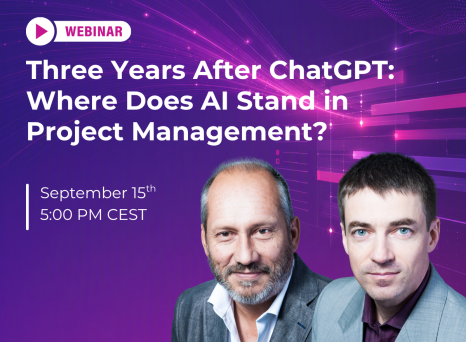
What does it take to become a truly project-driven organization? In this Planisware webinar, Antonio Nieto-Rodriguez and Brianna Halot from Planisware discuss project prioritization, AI, critical thinking, leadership and the shift from managing projects to creating value.
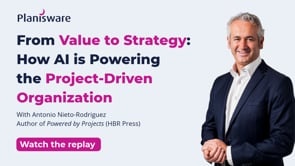
For decades, organizations have invested heavily in perfecting how they run their operations, refining processes, hierarchies and management systems to deliver predictable results at scale. Today, however, their ability to compete depends less on how efficiently they run and more on how effectively they can transform. This was the central theme of a recent Planisware webinar. In it, Brianna Halot from Planisware spoke with Antonio Nieto-Rodriguez, former Chairman of PMI, Vice President of the Association for Project Management and author of Powered by Projects (HBR Press). The conversation went well beyond the mechanics of project management. It explored what it really means to become a project-driven organization, how leaders can focus their resources on the initiatives that matter most, and where AI fits into this shift.
For Antonio Nieto-Rodriguez, the starting point is that most organizations were never designed for continuous change. As he put it:
"Most companies are not prepared for transformation. They're prepared for stability." — Antonio Nieto-Rodriguez
Projects are becoming the engine of transformation
For much of the last century, the organizational model was built around running operations efficiently, and for good reason: stable operations generated predictable value. That balance is now shifting. As routine operational work becomes increasingly automated, a growing share of people's time is being spent on projects, product development and transformation initiatives. Antonio Nieto-Rodriguez argues that organizations therefore need to develop what he calls a "transformation muscle". This is a lasting ability to adapt, rather than an approach that treats transformation as a one-off program launched every few years.
This shift fundamentally changes the role that projects play within the business. Projects are no longer simply vehicles for delivering outputs on time and on budget. They are increasingly the means by which organizations turn strategy into change, and change into value. Antonio Nieto-Rodriguez summed it up clearly:
"Your projects are your future. The real reason why we do projects is to build a better future, to create more value, to create more impact."
If projects are where the future of the organization is built, leaders also need to rethink how they spend their own time. During the webinar, Antonio Nieto-Rodriguez suggested that senior leaders should dedicate around 60% of their time to projects and transformation activities. During periods of major change, that share could rise to as much as 80%. This is a significant departure from the traditional view of executive work as primarily focused on running the business rather than changing it.
Doing fewer projects may create more value
Becoming more project-driven does not mean launching more projects. In fact, one of the most provocative recommendations from the conversation pointed in exactly the opposite direction:
"One thing that can help you have less project failure is very simple: having fewer projects." — Antonio Nieto-Rodriguez
Many organizations spread their people, budgets and leadership attention across far too many initiatives at once. When everything is treated as a priority, resources become fragmented, and the strategic initiatives that deserve the most focus rarely get it. Reducing the number of active projects makes it easier to allocate resources properly, set clear priorities and give teams the attention and support they need to deliver. Antonio Nieto-Rodriguez even proposed a simple, practical rule: before launching a new project, finish or cancel two existing ones.
In practice, however, stopping a project is rarely straightforward, particularly when leaders and teams have invested time, resources and personal credibility in it. Brianna Halot raised this challenge directly during the discussion:
"Stopping a project can be personal. How do you make it a bit less personal? Is there anything you should agree on before stopping the project, and how should teams be protected so they're able to say, 'Stop'?" — Brianna Halot, Planisware
Much of the answer lies in culture. Organizations need to create an environment where stopping an initiative that no longer delivers value is recognized as a sound business decision rather than a personal failure. For Antonio Nieto-Rodriguez, this means changing how organizations think about projects in the first place:
"Projects are experiments. Some will win, some others will learn. That's how we need to change that. That's why culture is so important." — Antonio Nieto-Rodriguez
Seen this way, portfolio management is not only about deciding what to start. It is an ongoing discipline of deciding what to continue, what to change and what to stop, so that resources keep flowing toward the initiatives most likely to create value.
AI can save time, but can it improve decisions?
AI adds a new dimension to this shift. Today, its most immediate contribution to project management is productivity. Antonio Nieto-Rodriguez described using AI extensively in his own work and highlighted its potential to remove much of the administrative burden that surrounds projects, from reporting to documentation.
Planisware's research suggests, however, that many organizations have not yet moved beyond these productivity gains to use AI where it could have the greatest strategic impact: portfolio-level decision-making. As Brianna Halot explained during the webinar:
"We found that 57% of the people who are using AI use it in execution, but not yet in portfolio management, where it's only 29%. Most of all, the payoff is time, not better decisions." — Brianna Halot, Planisware
This gap is significant, because the longer-term promise of AI lies not in generating reports or taking meeting minutes faster. It lies in AI's ability to analyze large volumes of portfolio data, explore alternative scenarios and support better investment and prioritization decisions. Realizing that promise depends heavily on trust. Planisware's research found that portfolio managers were the group that trusted AI the least. A key reason was whether they could trust the underlying data enough to rely on AI-generated insights, especially for decisions they would later have to defend in front of executives or the board. Adopting AI in portfolio management is therefore as much a data, governance and human challenge as it is a technological one.
Critical thinking becomes more important, not less
If AI can analyze information, automate administrative tasks and help model possible scenarios, it is natural to ask which skills will matter most for project and portfolio leaders in the years ahead. For Antonio Nieto-Rodriguez, one answer stands above the rest: critical thinking.
AI gives leaders the opportunity to challenge assumptions and explore possibilities that previously would have required far more time and effort. Yet it does not remove the need for human judgment. If anything, it makes that judgment more valuable. Brianna Halot emphasized this point during the discussion:
"Critical thinking is something that's going to stay with humans and not with AI. It's tempting to look at AI in a way that mitigates our critical thinking, but actually the people who will really come out of it are the ones who are strengthening that skill." — Brianna Halot, Planisware
The same reasoning applies to accountability. AI can contribute information, analysis and recommendations, but responsibility for the final decision must still rest with someone. As Brianna Halot noted:
"Human decision is still going to be part of it, because there also needs to be a person behind that who holds accountability." — Brianna Halot, Planisware
This distinction becomes even more important as organizations move from generative AI toward AI agents that can interact with business systems and carry out actions on their own. Antonio Nieto-Rodriguez cautioned that AI outputs must always be checked. Responsibility for what is ultimately used, shared or acted upon remains firmly with people.
Transformation is still about people
Perhaps surprisingly, a conversation about project-driven organizations and artificial intelligence ultimately came back to something deeply human: teams. Technology can help organizations work faster and process more information than ever before. But successful projects still depend on people who trust one another, feel confident enough to challenge decisions and understand the purpose behind their work.
Antonio Nieto-Rodriguez observed that organizations often bring people together around a project without ever truly creating a team. Instead, leaders should deliberately build an environment in which people feel safe asking for help, questioning assumptions and taking calculated risks. The same principle applies at leadership level. Project leaders and PMOs need the confidence to push back on senior stakeholders when a project lacks resources, sponsorship or a credible link to strategic value. They also need to learn to communicate in the language of those stakeholders, whether that means talking about return on investment with finance leaders or about strategic outcomes with the executive team.
From managing projects to managing value
The transition toward a project-driven organization cannot be achieved simply by adopting a new methodology or deploying AI tools. It requires organizations to rethink how they allocate resources, how their leaders spend their time, how projects are prioritized and stopped, and ultimately how success itself is defined. AI can certainly accelerate that transition by automating low-value tasks, analyzing data, supporting scenario planning and helping teams move faster. But technology alone cannot decide which future an organization should build. That responsibility remains with its people.
Perhaps that is the simplest way to think about the future of project management. As Antonio Nieto-Rodriguez reminded the audience:
"When somebody asks you, 'What's your job?' you can say: 'I'm building the future of my organization.'"
For PMOs, project leaders and executives alike, the challenge now is to make sure that the projects shaping that future are the ones that truly deserve the organization's time, resources and attention.