Discover how Planisware’s partnership‑driven, five‑phase onboarding approach helps organisations confidently adopt Orchestra and unlock long‑term project portfolio management success.
The biggest challenge in onboarding a Project Portfolio Management (PPM) solution isn’t the technology itself; it’s the change it demands during the onboarding process and knowing where exactly to start.
You know that soon you’ll have all your data in one place for that unified source of truth, your communication with different offices will be one step ahead with shared dashboards and real-time updates sent to you, sharing one consistent story across the entire portfolio. That’s why you chose Planisware Orchestra. But what are the steps needed to actually start seeing some of those transformative benefits? How do you ensure the right people are using Orchestra’s features correctly to make your job more straightforward?
Onboarding is a crucial time that sets a foundation of how your team will build confidence in the PPM solution for long-term success. That’s why, at Planisware, we work in partnership with you to understand your needs from Orchestra and embed a staged onboarding process to gain momentum for long term impactful usage.
In this article, we’ll uncover the role of partnership in onboarding and the recommended steps for you to see value from Orchestra from the get-go.
The role of partnership in onboarding
Building a successful partnership helps us at Planisware to best guide you on the right approach to introduce Orchestra to your team and ensuring that adoption has lasting value. Our role is to lead that collaboration to turn our tool into a strategic enabler for your business.
How we’ll work with you
We’ll help to define your objectives: This involves looking at your broader business objectives, where you want to be in 6 months, 12 months, 24 months and aligning Orchestra to fit with these goals. This will highlight the features your team relies on most, allowing us to prioritise implementation in the order that delivers the greatest value.
Open communication and long-term collaboration: The more open the communication, the fewer blind spots arise enabling much faster problem solving in the onboarding process. Collaboration is what creates a smooth path to being fully integrated with Orchestra.
Team training and feedback: To make Orchestra truly yours, it’s important to get your team on board early with tailored training. These are the people who will be using the tool every day and they’ll ensure it stays a consistent source of truth, but only if they know how to best use the tool, and it’s customised with their needs. We’ll work with you to transform collected feedback into meaningful platform customisations that enhance usability and deliver greater value to your team.
Performance metrics and continuous improvement: Alongside feedback, we’ll closely track KPIs to measure success. This will flag opportunities to make better refinements to measure success and drive ongoing enhancements through regular reviews and refinements.
Risk management and market awareness: By keeping the conversation open, we can spot risks early, tackle them together, and stay ahead of market and tech shifts so nothing catches us off guard. It’s not just about avoiding problems but being able to adapt to change with resilience.
Celebrating successes: We believe it’s important to celebrate each milestone achieved; every time we collectively get one step closer to being fully intergrade with Orchestra. They’re not just checkpoints; they’re opportunities to reinforced momentum across your organisation.
Leveraging success, sharing accountability
True success with Orchestra is never the result of one party working in isolation or the tool working on its own. It emerges from a partnership where each side brings its strengths to the table.
We’ll bring best practices and proven methodologies, and you’ll bring a Product Owner who will be taking ownership of design choices, implementation decisions, and ongoing refinements. Through this partnership, we ensure our work remains tethered to strategic goals, even once Orchestra becomes part of business-as-usual operations.
Image
Image
Five phases that turn onboarding into strategic advantage
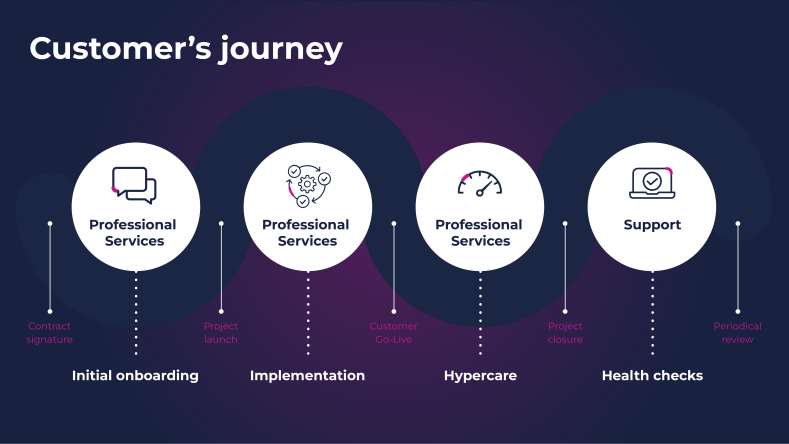
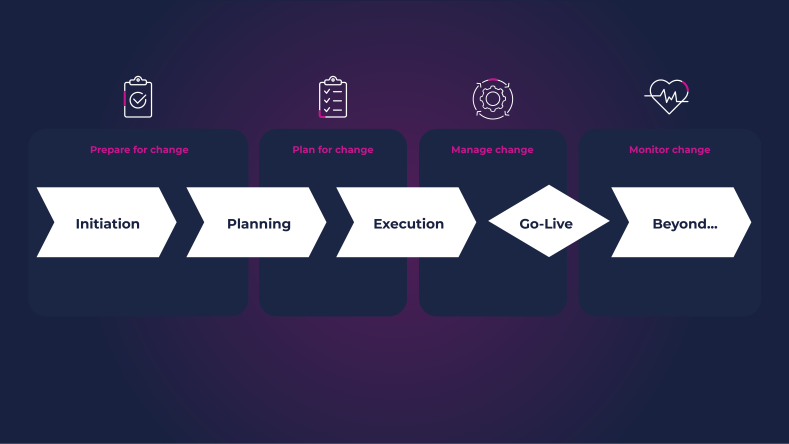
Onboarding isn’t just about getting a system live, each phase should build confidence. To make the journey smooth and successful, we follow a structured five-phase approach. Each phase is designed to reduce blind spots and keep you agile as you manage a huge change in how you manage your portfolios and work with your team.
Phase 1: Initiation and introductions
Initiation is a real launch pad into a new chapter of project portfolio management, setting the stage for clarity. This is where we start our partnership. You’ll meet with our implementation experts so they can map out the onboarding process by listening to your business objectives. We’ll host plenty of discussions to ensure your needs are met and keep you supported from start to finish.
The focus here is on people, ensuring continuity from the sales team to project delivery experts, and clarifying roles.
Phase 2: Structuring the path forward
Preparation is key to transforming momentum into a clear plan of action. This phase is about laying the operational and functional groundwork for success. We recommend embracing an out-of-the-box functionality because not only does it get the ball rolling, but it helps organisations avoid reinventing processes and ensures their implementation follows industry best practices from day one.
This gives us a great starting point to see what’s working well and what needs tweaking.
It’s important to remember this isn’t just a software implementation, it’s a business process improvement initiative. The software is only one part of the solution. People and processes may need to evolve for the benefits to be fulfilled.
In phase two, you’ll be given access to Orchestra Engage, our step-by-step e-learning platform and training environment access for risk-free practice.
Phase 3: Fine tuning and execution
This is the phase where we will tailor the platform to your needs. Expect functional and technical workshops, and hands-on configuration guidance between your team and ours. These are conversations that will shape the platform around your team’s needs. This is the time we’re building confidence, preparing the data and getting the environment right so everything is ready for success.
Phase 4: Time to go live
Now the training has been delivered, and the platform has been finetuned to your needs, it’s time to go live and get properly started on PPM success. Support is there through the customer support platform and with our dedicated team overseeing your onboarding to ensure this process is smooth every step of the way.
After deployment, we’ll meet to review any immediate feedback and address any concerns you may have. As the system settles into business-as-usual, the focus shifts from project delivery to operational excellence so we can keep collectively driving improvements as portfolios grow.
Phase 5: Looking ahead
Now our focus shifts to long term excellence so you can be innovative and adapt as new governance is required and portfolios evolve. We see support as the strategic enabler that makes Orchestra the success story it is for countless organisations.
Once the platform is live, day-to-day stability is maintained through structured processes that make support predictable and effective. Issues are logged through a ticketing system, which ensures every bug or request is tracked, prioritised, and resolved in a transparent way.
Support operates at multiple levels. At Level 1, frontline teams, either your own administrators or Planisware’s customer support, handle common questions and straightforward fixes. If the issue requires deeper expertise, it escalates to Level 2, where solution consultants’ step in to diagnose and resolve more complex problems. For the most technical challenges, such as software bugs or feature requests, Level 3 involves the development team directly.
To keep everything timely, Service Level Agreements (SLAs) define clear response and resolution targets, so you know when to expect progress. Alongside this, a knowledge base and AI-powered search tools give your team self-service access to documentation, FAQs, and best practices. And when needed, you can connect directly with technical experts for guidance.
In practice, this means that after you go live, your organisation isn’t left to figure things out alone, there’s a structured, tiered system ensuring that any issues are tracked, prioritised and resolved, so everything can be handled without delay.
Why a phased approach is important
We have found this five-stage process has accelerated project portfolio success without overwhelm rather than leaving you with the tool. We’ve designed the onboarding to be engaging and empowering, so information can be digested and your team feels confident before we go live. An integration of sandbox environments and blended training formats means all different learning styles are considered.
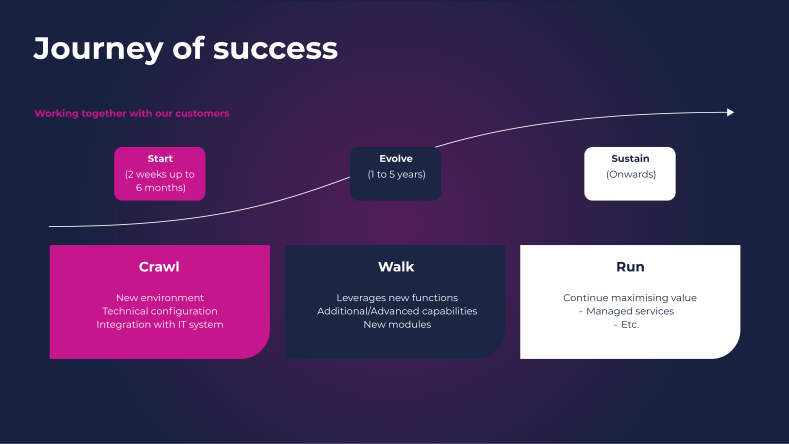
We call this the Journey of Success; a five-staged path that delivers lifetime value to our customers. It’s not about adopting a tool but achieving lasting portfolio maturity.
Image
Insights from our team
“Onboarding Orchestra isn’t just about deploying software – it’s about enabling people, refining processes, and driving meaningful change. With the right preparation, clear goals, and a collaborative mindset, onboarding becomes a strategic journey that delivers value without complexity. It’s not just about getting started – it’s about setting the stage for long-term success. We’re here to guide, support, and celebrate every milestone with our customers.”
— Sonja Anderson, Principal Solution Consultant for Orchestra at Planisware
Image

Ready to get started?
Whether you’re preparing for onboarding or simply exploring what Orchestra can bring to your organisation, the journey starts with a conversation. Our team is ready to guide you step by step. Connect with us today or book a demo, and let’s orchestrate the future together.