
What is project portfolio management (PPM)?
A project portfolio is a collection of projects and programs grouped together to achieve an organization’s strategic objectives. When implemented into a framework, project portfolio management (PPM) is a strategic approach used to evaluate, prioritize, and coordinate the elements of that project portfolio.
Using a series of tools, methodologies, and strategies, PPM involves consolidating large amounts of data about the contents of a project portfolio, with the primary objective of ensuring that all outcomes within the project portfolio support the business’s strategic goals.
PPM uses data to assess not only strategic importance but also resource usage and profitability. These insights drive informed decision-making around which projects to select, how to prioritize and sequence them, where to allocate resources, and how to manage risks, ultimately grouping projects in a way that:
- ensures the optimal use of existing resources
- leverages common work products and processes
- balances risk, costs, and constraints
- anticipates capacity and resource needs
- meets strategic objectives
PPM shares similarities with enterprise project portfolio management (EPPM). While PPM focuses on overseeing projects and programs across one specific area of a business, EPPM takes an even higher level view across an entire organization. It refers to managing the business’s entire project portfolio suite simultaneously.
Roles and responsibilities involved with PPM
PPM typically falls under the responsibility of the project management office (PMO), which uses PPM software to work more efficiently and effectively. Key duties include:
- Strategic alignment and standardization
- Portfolio centralization and visibility
- developing a centralized view of all projects accessible to stakeholders
- identifying and consolidating projects, their characteristics, and their teams
- establishing protocols for ensuring data accuracy and access
- Resource and financial management
- prioritizing tasks and allocating resources (such as time, budget, and team members)
- defining and presenting financial and resource constraints
- managing, anticipating, and forecasting costs to maximize project/portfolio ROI
- Performance monitoring and communication
- monitoring and tracking key performance indicators (KPIs)
- measuring project impact in real-time and providing accurate, reliable reporting
- facilitating cross-team communication
Benefits of project portfolio management
PPM provides an objective, measurable framework for deciding what projects will deliver the greatest value to your organization. At the same time, it helps mid-size and larger organizations scale Agile methodology, benefiting decision-making, visibility, and operations.
Data-driven decision-making
PPM empowers PMOs to make data-led decisions about how to select, prioritize, authorize, and manage projects. It helps you ensure the right resources are assigned to most appropriate projects in the most effective way possible.
You can make informed and evidenced choices about whether to continue or kill projects, whether to hire more people, or whether to do project A or project B. This may involve advanced techniques, such as scoring mechanisms.
PPM gives you focus on the bigger picture and your long-term goals. There is no bias or favoritism—all projects are viewed objectively in terms of their ability to drive value.
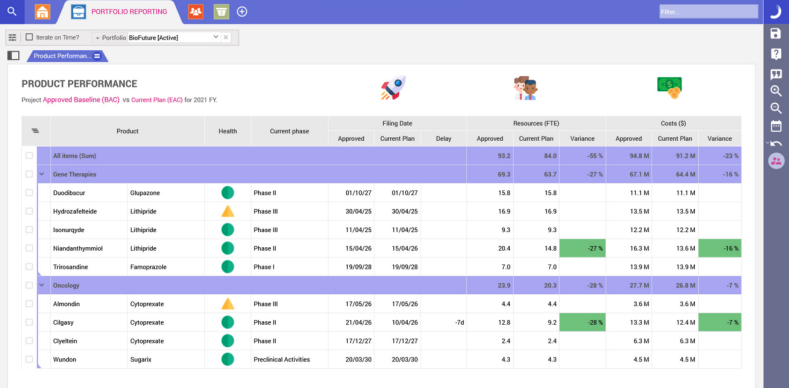
Portfolio health dashboard in Planisware
Strategic visibility and control
PPM gives you a centralized view of current and future projects, promoting better alignment and prioritization of projects with your overarching business plan.
It provides a systematic way of capturing and sharing information across project portfolios, providing decision-makers with the data they need to make smart, timely decisions throughout project lifecycles. You have real-time insights into costs, return on investment (ROI), resource allocation, and strategic impact.
To facilitate this, PPM software solutions give access to a range of clear, easy-to-read dashboards to visually represent all this data in one place. As well as improving accountability, this gives stakeholders access to (and trust in) your organization’s data.
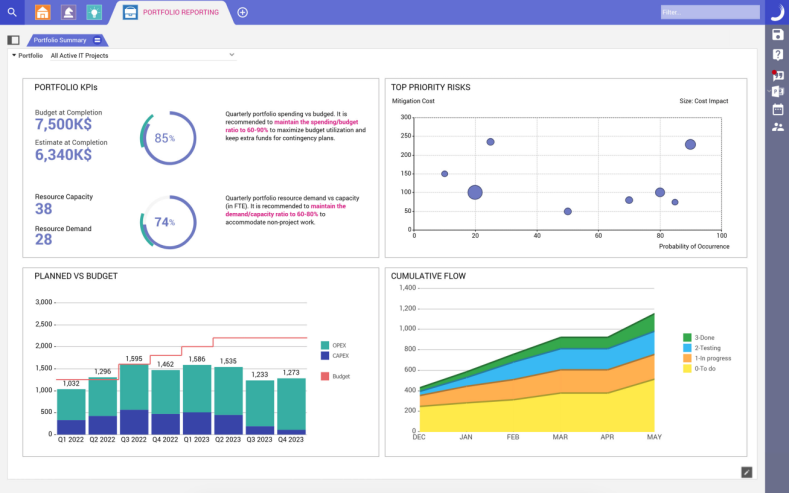
Portfolio overview dashboard
Operational efficiency and maturity
Day-to-day, implementing PPM can help your teams complete projects on time, in scope, and within budget. Taking things a step further, PPM software creates a single source of truth and includes a range of collaboration features which can improve information sharing and alignment across a project portfolio.
At a more organizational level, PPM builds transparency and good governance by tracking past, current, and forecasted work in real time. It leverages historical insights to optimize future project selection and resource allocation.
PPM also helps you align your organization’s best practices with its maturity level. Let’s say you are a rapidly-scaling mid-sized business. Rather than relying on simple ROI calculations, you may start to employ predictive AI analytics and “what-if” scenario planning to optimize your project portfolios.
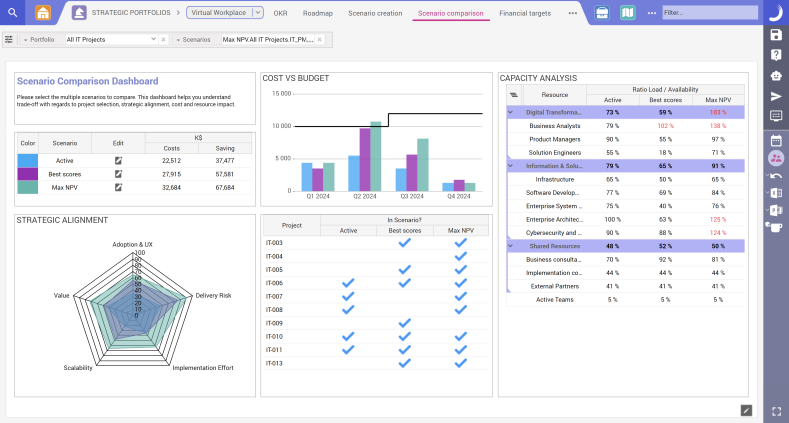
Scenario comparison dashboard
Tailoring PPM to your priorities and objectives
Every organization deploys PPM differently. The approach you choose will be shaped by your business, your industry, and the initiatives and priorities that matter most to you.
If you are a corporate consumer goods organization, your PPM implementation may take on a more financial and strategic complexion. However, if you’re based in a highly-regulated industry, such as aerospace and defense, a PPM approach emphasizing resource and risk management may best suit you.
Your PPM implementation could focus on:
- Strategic alignment: This approach focuses on connecting your project portfolio’s execution to the organization’s vision—also known as strategic portfolio management (SPM). Essentially, projects will be evaluated based on their support for the broader business strategy. Effective SPM ensures investments and resources focus on the initiatives that drive your strategy forward, even as it evolves.
- Governance: A lack of standardization can slow things down, cause confusion, and waste resources. Governance-focused PPM aims at developing standardized processes, practices, and templates that everyone in the organization must follow. This ensures consistency, improves comparability, and helps create a more integrated business.
- Risk management: The objective here is to minimize risk exposure across an organization. Diversified projects and programs may be chosen, ensuring a mixture of stability with some managed risk. This approach may entail rigorous risk assessment frameworks to account for any potential disruption.
- Resource management: This approach emphasizes the importance of efficient deployment of finite resources, such as budget, time, and team members. This ensures resource allocation is highly precise and workloads are carefully balanced, avoiding bottlenecks while maximizing returns.
- Financial management: This focus ensures every portfolio is cost-effective and drives ROI. It is particularly beneficial for businesses relying on financial impact for its decision-making. It can be characterized by detailed modeling and forecasting for all projects and programs. It may also involve strict budget controls and kill switches for underperforming projects.
The process of adopting and integrating PPM can be broken down into five stages which we outline in more detail in our step-by-step guide on how to design and implement a PPM process.
How can software help with project portfolio management?
With a range of features and capabilities, PPM software empowers PMOs and leaders to execute all of their portfolio management duties, including:
- Demand management: PPM software can help you to collect, centralize, and process all of the proposals (or “demands”) that may impact your current or future projects. It helps you to assess their value and cost and ensure there is a connection between an expressed need and what is eventually implemented.
- Portfolio management: PPM solutions give you access to features that help you to formalize strategy, consolidate projects, identify constraints, and adjudicate between various different scenarios. This helps to avoid duplication and focus on those projects that add value.
- Project and product management: Features such as interactive Gantt charts, to-do-lists, and Kanban boards can facilitate day-to-day project planning. Templates can be used to standardize your best practices, and progress can be tracked by following milestones and deliverables.
- Resource management: By gaining real-time visibility into resource allocation and utilization across all projects, PPM tools help leaders to anticipate capacity, optimize workload, analyze time distribution, and gain insights on all activities—all in a single timesheet.
- Budget and cost management: PPM solutions can give you a centralized view of all your project costs, allowing you to anticipate, analyze, and manage your budgets, whether globally or with granularity.
Collaboration and reporting: PPM creates a central hub for past, ongoing, and forecasted project data, accessible to all relevant stakeholders in the business. This allows decision-makers to not only observe progress in real time, but anticipate problems and act with confidence.
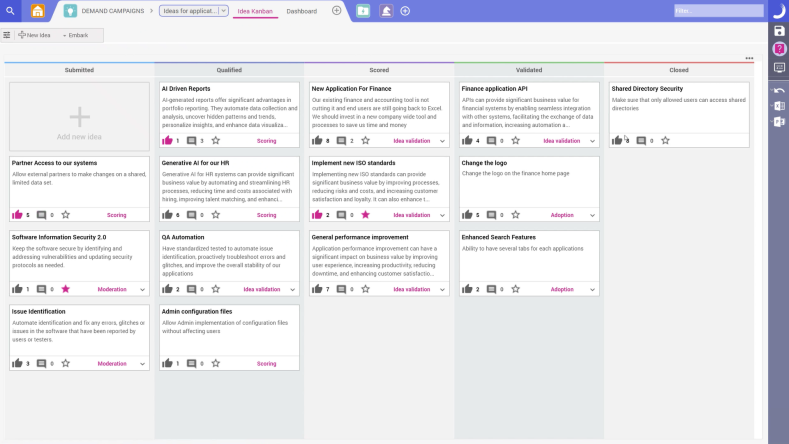
Demand management in Planisware Enterprise
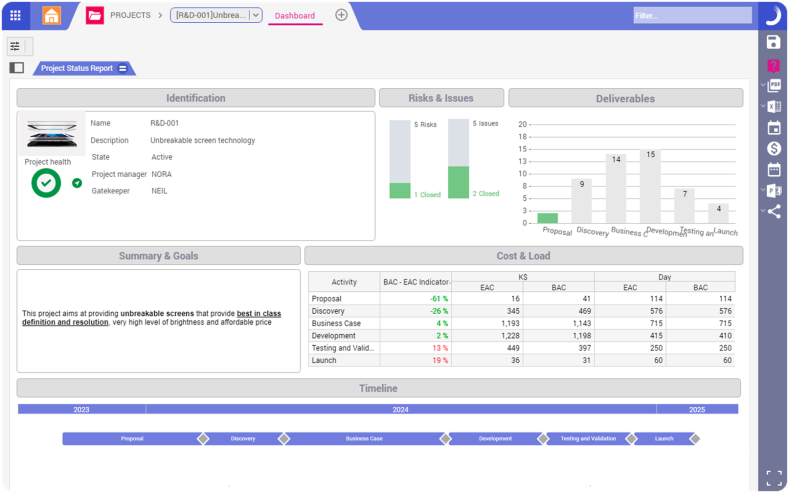
Project and product management
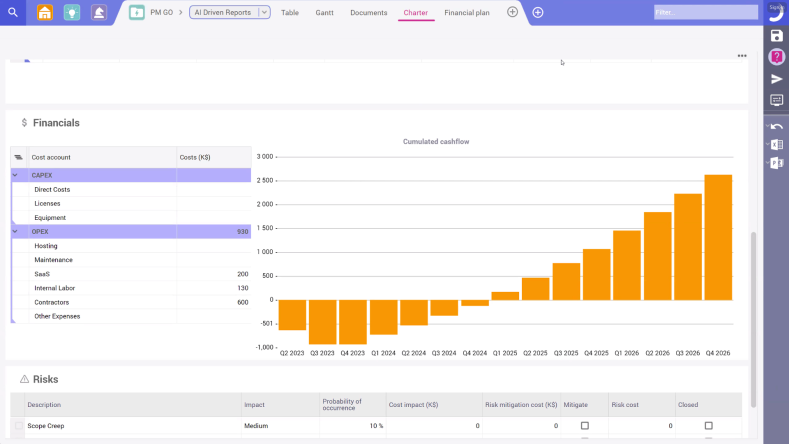
Budget and cost management
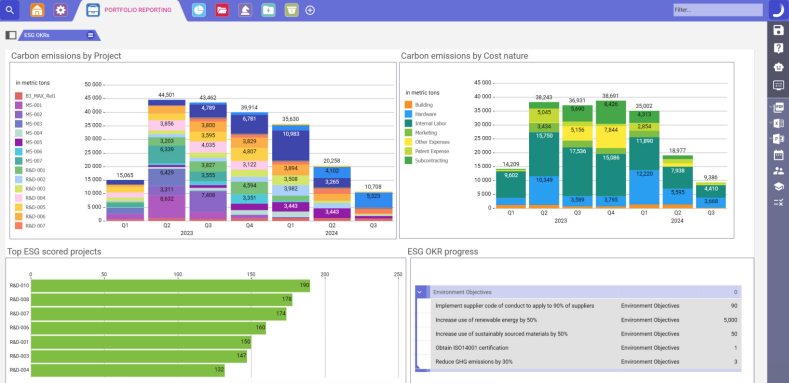
ESG OKR portfolio reporting
With innovative, industry-leading capabilities, Planisware is the trusted PPM software solution of global leaders including Ford, Nutrien, Airbus, Societe Generale, PepsiCo, and Philips.
Book a one-to-one demo to discover how Planisware can help you better manage your organization’s project portfolios and start driving maximum strategic value.
Key tools for effective PPM
Most organizations rely on a combination of portfolio-level capabilities (to prioritize investments, allocate funding and capacity, and steer outcomes) plus team-level execution tools (to plan and deliver the work).
Planisware (PPM platform for departmental to enterprise needs): Planisware supports end-to-end portfolio governance—from strategic planning and scenario evaluation through execution, financials, and analytics—so leaders can connect decisions to delivery in one environment. It can be positioned to match your organization’s scope and maturity (from a single department to a global rollout), with options for cloud and on-premise deployment, a large long-standing customer base, and recognition from industry analysts such as Gartner, Forrester, IDC, and Info-Tech Research Group.
Microsoft Project: Often used for detailed scheduling and project control, and (in its online services) supports planning, prioritizing, and managing projects and project portfolio investments.
Trello: A lightweight, visual Kanban approach that teams use to track work through stages on a shared board.
Asana: A work management tool that includes portfolio views for monitoring multiple projects together, with dashboards and status updates to support cross-team coordination.
In practice, many PMOs standardize portfolio decision-making in a dedicated PPM platform and connect it to the tools delivery teams already use (for example, Planisware supports bi-directional integration with Microsoft Project).
Going one step further: 14 academic must read about Project Portfolio Management (PPM)
What is PPM?
The Project Management Institute (PMI) defines portfolio management as the centralized management of one or more portfolios, enabling organizations to achieve their strategic objectives through the identification, prioritization, authorization, and oversight of projects and programs. PMI's published research on project portfolio management techniques further illustrates how structured intake and selection processes translate high-level strategy into an executable set of initiatives—a distinction that becomes increasingly consequential as the number of concurrent projects grows. For those building familiarity with the foundational standards that govern the discipline, the PMI Standard for Portfolio Management provides a clear overview of the governance principles, performance domains, and practices that underpin effective portfolio oversight.
Strategy and resource allocation
The connection between portfolio management and enterprise-wide resource allocation is well-documented in management research. A McKinsey analysis on matching the right projects with the right resources shows that organizations aligning their workforce and capital with their highest-priority initiatives consistently outperform those that allocate resources by inertia—and that active portfolio rebalancing, rather than incremental budgeting, is the lever most likely to produce meaningful shifts in performance. McKinsey's broader research on strategy and resource allocation reinforces this finding: companies that actively reallocate resources across business units generate substantially higher returns than those whose budgets remain static year over year. At the executive level, the HBR article on the office of strategy management argues that bridging the gap between strategy formulation and day-to-day portfolio decisions requires a dedicated governance function—one that connects planning cycles, capital review, and project prioritization in a continuous loop rather than an annual exercise. More recently, HBR's work on lean strategy-making has extended this argument, demonstrating how organizations that treat strategy as an ongoing, iterative process—rather than a fixed annual plan—respond more effectively when market conditions shift and portfolio priorities need to change.
Portfolio governance and best practices
Understanding what makes a portfolio succeed—distinct from what makes individual projects succeed—is a distinction that research has been slow to formalize, but one that practitioners increasingly recognize as fundamental. PMI's paper on refining portfolio success and its antecedents identifies three dimensions that matter: strategic fit, the exploitation of portfolio value, and stakeholder satisfaction—none of which reduces to on-time, on-budget delivery at the project level. The same body of work cautions that organizations often conflate project performance with portfolio performance, a misalignment that produces well-executed projects that nonetheless fail to move the strategic needle. PMI's analysis on discriminating between strategy and projects in portfolio management sharpens this further, arguing that the original purpose of the discipline was precisely to address the gap between strategic intent and competing investment priorities—not to serve as a reporting layer on top of existing project delivery. For organizations translating these principles into practice, peer-reviewed research in the International Journal of Innovation and Technology Management links PPM implementation quality directly to strategic objective attainment, offering empirical grounding for the governance investments that many PMOs are regularly asked to justify internally. A practitioner-oriented guide covering the full PPM lifecycle—from strategy through governance to execution—serves as a useful complement to the academic literature for teams building or maturing their portfolio management process.
Key tools for effective PPM
The market for PPM tools has matured considerably, and analyst firms now provide structured frameworks for evaluating vendors across dimensions that go well beyond feature checklists. An overview of PPM tools evaluated through the Gartner Magic Quadrant and other analysts shows how the analyst community assesses platforms against criteria including deployment flexibility, integration breadth, scalability, and the ability to support both departmental and enterprise-grade use cases from a single platform. Forrester's Q2 2025 assessment of collaborative work management tools draws a clear line between general-purpose platforms and dedicated PPM systems, noting that while CWM tools serve team-level execution well, they fall short when organizations require portfolio-level financial modeling, scenario analysis, or cross-portfolio governance at scale. For organizations in innovation-intensive industries, research published in the Strategic Management Journal provides academic validation for the principle that how an organization allocates resources across its innovation portfolio determines not only short-term output but long-term competitive positioning—which makes the choice of PPM platform a strategic decision, not simply a software procurement exercise.
Frequently Asked Questions
What resources can I consult for more information about project portfolio management (PPM)?
The following Planisware resources provide deeper guidance on project portfolio management concepts, tools, and best practices:
- Project Management Office (PMO) — Understand how the PMO function relates to and enables effective PPM governance across the enterprise.
- Portfolio Management Guide — A comprehensive guide covering portfolio selection, prioritization frameworks, and execution strategies for portfolio leaders.
- Resource Management in PPM — Explore how capacity planning and resource allocation underpin successful portfolio delivery.
- Strategic Alignment — Learn how organizations connect project portfolios to corporate strategy and business objectives.
- Project Prioritization — Discover frameworks and scoring models used to rank and select projects within a portfolio.
- PPM Best Practices — Actionable recommendations for maturing your portfolio management process and improving decision-making.
- How to Select PPM Software — A buyer's guide to evaluating and choosing the right project portfolio management platform for your organization.
- PMO vs. PPM: Key Differences Explained — Clarifies the distinct roles of the PMO function and portfolio management discipline for organizational leaders.
What is project portfolio management (PPM)?
Project portfolio management (PPM) is the centralized, coordinated management of a group of projects and programs to achieve strategic business objectives. Rather than managing individual projects in isolation, PPM gives organizations a structured way to evaluate, select, prioritize, and oversee all projects as a unified portfolio — ensuring resources and investment flow toward the initiatives that deliver the greatest value.
At its core, PPM addresses three fundamental questions:
- Are we doing the right projects? — Selecting initiatives aligned to strategy
- Are we doing them the right way? — Applying consistent governance and methodology
- Are we getting the most from our resources? — Optimizing capacity and investment
According to PMI research, organizations that implement mature PPM practices waste 28 times less money than those with low PPM maturity — a compelling case for executive investment. PPM is distinct from project management, which focuses on delivering a single project on time and on budget. PPM operates at a higher strategic level, balancing risk, return, and organizational capacity across the entire project landscape. For organizations looking to align execution with strategy, platforms like Planisware provide the visibility and decision-support capabilities that enterprise PPM demands. Explore the PMO glossary for related foundational concepts.
What is the difference between project portfolio management and project management?
Project management and project portfolio management operate at fundamentally different levels of an organization — one focuses on execution, the other on strategic investment decisions. Understanding the distinction is essential for leaders designing governance structures that work at scale.
| Dimension | Project Management | Project Portfolio Management |
|---|---|---|
| Scope | Single project | All projects and programs enterprise-wide |
| Primary goal | Deliver on time, on budget, on scope | Maximize strategic value and ROI across the portfolio |
| Key decisions | How to execute a defined initiative | Which initiatives to fund, prioritize, or stop |
| Audience | Project managers, delivery teams | C-suite, PMO directors, portfolio owners |
| Time horizon | Project lifecycle | Annual planning cycles and beyond |
A project manager asks: "How do we deliver this initiative successfully?" A portfolio manager asks: "Should this initiative exist in our portfolio at all — and at what investment level?" Organizations that conflate the two roles often struggle with resource conflicts, misaligned priorities, and strategic drift. The PMO function typically bridges both disciplines, translating portfolio-level decisions into project-level execution. For a deeper look at how PPM governance structures work in practice, explore Planisware's portfolio management guide.
What are the key benefits of project portfolio management for large organizations?
For enterprise organizations managing dozens or hundreds of concurrent initiatives, PPM delivers measurable improvements across strategic alignment, resource efficiency, and risk management. The benefits compound as portfolio maturity increases.
Core benefits by category:
| Benefit Area | What It Delivers | Business Impact |
|---|---|---|
| Strategic alignment | Projects mapped to corporate objectives | Investment concentrated on highest-value work |
| Resource optimization | Capacity visibility across all projects | Reduced bottlenecks, fewer over-allocated teams |
| Risk management | Portfolio-level risk aggregation and balancing | Fewer costly project failures and surprises |
| Financial control | Consolidated budget tracking and forecasting | Improved ROI visibility and spend accountability |
| Decision quality | Data-driven prioritization and scenario modeling | Faster, more confident executive decisions |
Research from Gartner indicates that organizations with mature PPM capabilities achieve up to 40% better project success rates compared to those without formal portfolio governance. A global manufacturer, for example, might use PPM to identify that 30% of active projects have low strategic value — reallocating that capacity to innovation initiatives with measurable revenue impact. Planisware's PPM best practices resource outlines how leading organizations structure their portfolio governance to capture these benefits systematically.
What is the difference between a PMO and PPM?
The PMO (Project Management Office) and PPM (Project Portfolio Management) are closely related but serve distinct purposes — a distinction that matters significantly when designing organizational governance structures.
- PPM is a discipline and process: the methodology, frameworks, and decision-making practices used to manage a portfolio of projects strategically.
- The PMO is an organizational function: the team or office responsible for implementing, governing, and continuously improving those PPM practices.
In practical terms, the PMO is the engine that runs PPM. It establishes standards, maintains portfolio visibility, facilitates prioritization decisions, and ensures projects are executed consistently. Without a functioning PMO, PPM processes often lack the organizational ownership needed to sustain them. Conversely, a PMO without a PPM framework risks becoming an administrative overhead rather than a strategic enabler. According to PMI's Pulse of the Profession, organizations with a dedicated PMO complete 63% more projects on time and on budget than those without one. Understanding how these two concepts interlock is foundational for any executive building or restructuring portfolio governance. The Planisware PMO glossary and the PMO vs. PPM explainer provide further clarity on how leading organizations structure these functions.
What are the best practices for implementing project portfolio management?
Successful PPM implementation requires more than deploying software — it demands a deliberate approach to governance design, stakeholder alignment, and process maturity. Organizations that treat PPM as a strategic capability rather than a reporting exercise consistently outperform those that do not.
Key implementation best practices:
- Establish a clear governance model — Define who owns portfolio decisions, at what thresholds, and through what review cadence before selecting any tools.
- Align portfolio criteria to strategy — Build project scoring and prioritization models that directly reflect corporate strategic objectives, not just financial metrics.
- Standardize data collection — Consistent project intake, status reporting, and resource data are prerequisites for meaningful portfolio-level analysis.
- Start with visibility, then optimize — Gain a complete view of the current portfolio before attempting prioritization or rebalancing exercises.
- Integrate resource and financial planning — PPM without capacity data produces incomplete decisions; connect project demand to workforce and budget supply.
- Build in regular portfolio reviews — Quarterly or monthly portfolio reviews ensure the portfolio adapts to changing business conditions, not just annual planning cycles.
- Invest in change management — PPM adoption fails most often due to cultural resistance, not technical limitations; executive sponsorship is critical.
Research by McKinsey found that companies with disciplined portfolio review processes are 2.5 times more likely to report above-average financial performance. Platforms like Planisware are designed to support these practices at enterprise scale, providing the scenario modeling and real-time portfolio visibility that mature PPM requires. For a structured starting point, explore the Planisware portfolio management guide.
How do PPM tools support better strategic decision-making?
PPM tools transform portfolio management from a manual, spreadsheet-driven process into a dynamic, data-informed capability — enabling executives to make faster, more confident investment decisions with full visibility into trade-offs and risk.
Core capabilities that drive decision quality:
- Portfolio dashboards — Real-time visibility into project status, health, budget consumption, and milestone progress across the entire portfolio
- Scenario modeling — The ability to simulate "what-if" portfolio configurations before committing resources or budget
- Capacity planning — Matching project demand against available resource supply to prevent over-commitment and burnout
- Prioritization scoring — Objective, criteria-based ranking of projects against strategic, financial, and risk dimensions
- Financial forecasting — Rolling budget forecasts that connect project-level spend to portfolio-level ROI targets
According to Forrester, organizations using dedicated PPM platforms reduce time spent on manual portfolio reporting by up to 50% — freeing PMO teams to focus on analysis and decision support rather than data aggregation. For example, a pharmaceutical company managing a pipeline of R&D and regulatory projects can use PPM tooling to model the impact of a delayed clinical trial on overall portfolio value — and rapidly reprioritize accordingly. Planisware's enterprise PPM platform is purpose-built for these complex, high-stakes portfolio environments. Explore the PPM software selection guide to understand what capabilities matter most at different levels of portfolio maturity.