
What Gartner’s Latest APMR Research Reveals About Modern Execution
What Gartner’s Latest APMR Research Reveals About Modern Execution
Organizations today are executing more initiatives than ever before. Digital transformation programs, product innovation cycles, IT modernization efforts, and operational improvements often run simultaneously—across different teams, geographies, and delivery models.
Each initiative comes with its own requirements, timelines, and governance approach, creating a level of complexity that traditional project management models were never designed to handle.
In its 2025 Critical Capabilities for Adaptive Project Management and Reporting (APMR) research, Gartner examines how modern platforms help organizations manage work in these increasingly complex environments. The report evaluates leading solutions based on capabilities such as resource management, hybrid methodology support, reporting, and integrations across enterprise systems.
In this research, Planisware Orchestra was evaluated among leading solutions in the APMR category and received strong assessments across several use cases, reflecting its ability to support organizations operating across complex and hybrid execution environments.
But the importance of this research goes beyond vendor evaluation.
Organizations are moving from managing projects to orchestrating execution across dynamic portfolios of work.
The Multimethod Reality of Modern Enterprises
For decades, organizations attempted to standardize project management around a single methodology—typically waterfall or a structured project lifecycle.
That model no longer reflects how work actually gets done.
Today, multiple ways of working coexist within the same organization. Agile product teams deliver continuous releases, while engineering projects follow structured milestones. At the same time, innovation programs explore new opportunities, and operational initiatives focus on efficiency and cost optimization.
These efforts differ not just in execution style, but in planning horizons, governance models, delivery cadences, and success metrics. The result is a fundamentally multimethod environment.
In this context, execution platforms must do more than enforce consistency. They need to provide visibility across diverse initiatives, enable coordination between teams, and maintain alignment with strategic priorities, without forcing everything into a single framework.
From Project Tracking to Adaptive Execution
Traditional project management tools were built for a more stable environment, one where plans were relatively fixed, priorities shifted slowly, and resource allocation was predictable. Their primary purpose was to track progress against a predefined plan.
That model is increasingly outdated.
Today’s organizations operate in conditions of constant change. Priorities evolve rapidly, resources are shared and constrained, and demand for new initiatives continues to grow. Dependencies across teams are also becoming more complex.
As a result, leaders are no longer just asking whether projects are on track. They are asking:
- What happens if we accelerate or delay a key initiative?
- Where will resources’ bottlenecks emerge?
- How should priorities shift given new constraints?
- Which initiatives will deliver the greatest impact now?
Answering these questions requires more than tracking—it requires continuous adaptation.
Modern execution platforms are designed to support this shift. They enable organizations to reprioritize dynamically, rebalance resources, and maintain visibility across portfolios in real time. This transition—from static planning to adaptive execution—is at the core of APMR.
Image
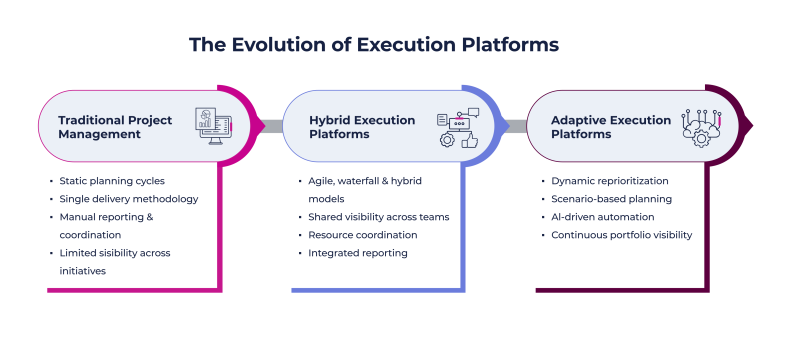
Figure: The evolution from traditional project management tools to adaptive execution platforms that support dynamic reprioritization, scenario planning, and AI‑assisted coordination.
The goal is no longer simply to track execution—but to adapt it continuously.
The Growing Role of AI in Execution Platforms
Artificial intelligence is accelerating this evolution.
The first wave of AI focused primarily on productivity—automating documentation, generating reports, and summarizing updates. While valuable, these capabilities only scratched the surface.
A second wave is now emerging, with a much greater impact on how organizations operate. AI is increasingly used to support execution orchestration—helping identify resource conflicts earlier, highlight risks based on historical patterns, and simplify complex portfolio views for decision-makers.
Rather than just reducing administrative overhead, these capabilities improve how organizations navigate complexity and make decisions.
Why Resource Coordination Is Becoming a Strategic Capability
As the number of concurrent initiatives grows, resource coordination has become one of the most critical drivers of execution success.
Leaders are constantly making trade-offs: deciding where to allocate scarce expertise, determining which projects can realistically run in parallel, and adjusting capacity as priorities shift.
Without the right tools, these decisions tend to be reactive, delayed, and based on incomplete information.
Adaptive execution platforms fundamentally change this dynamic. They provide visibility into resource allocation across initiatives, help anticipate constraints earlier, and allow organizations to explore alternative scenarios before committing. This enables a shift from reactive firefighting to proactive coordination—a key differentiator for high-performing organizations.
Supporting Adaptive Execution with Planisware Orchestra
Platforms like Planisware Orchestra are designed for organizations operating in this kind of dynamic, multimethod environment.
Rather than imposing a rigid structure, Orchestra provides the flexibility to manage different ways of working while maintaining a unified view of priorities, resources, and progress. It enables teams to coordinate across initiatives and adapt plans as conditions evolve.
By combining flexible work management, resource planning, and integrated reporting, Orchestra helps organizations move toward a more adaptive execution model—one that balances control with agility.
This allows leaders to maintain control and visibility, while enabling teams to operate with flexibility.
Why This Matters for PMOs
This shift has important implications for PMOs.
Historically, PMOs focused on enforcing processes, tracking timelines, and producing reports. Today, their role is expanding. They are increasingly responsible for coordinating execution across complex portfolios, aligning initiatives with strategy, managing resource constraints, and enabling adaptability.
To succeed in this role, PMOs need platforms that provide visibility across methodologies, support resource planning, and enable continuous reprioritization. Adaptive project management technologies are what make this evolution possible—transforming PMOs from administrative functions into strategic enablers.
The Future of Enterprise Execution
The pace of change is not slowing down. Organizations will continue to face increasing complexity, faster-moving priorities, and more interconnected teams.
In this environment, success will depend less on perfect planning and more on the ability to adapt continuously.
Execution platforms will play a central role in this transformation—helping organizations coordinate work across delivery models, anticipate resource constraints, simplify communication, and maintain alignment across evolving portfolios.
Adaptive project management is not just an incremental improvement. It represents a fundamental shift in how organizations execute strategy in a constantly changing world.